Inspired by PINA

Tags

, , , , , ,

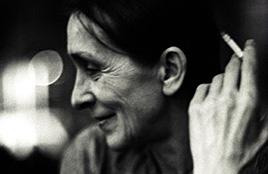
Paul and I recently watched Pina, a documentary about the work of German choreographer Pina Bausch, who died in the summer of 2009.

The music, the settings, the dancers, and their stories about Bausch are stuck in my head.

According to Pina‘s website, filmmaker Wim Wenders

… takes the audience on a sensual, visually stunning journey of discovery into a new dimension: straight onto the stage with the legendary Tanztheater Wuppertal Pina Bausch ensemble, he follows the dancers out of the theatre into the city and the surrounding areas of Wuppertal – the place, which for 35 years was the home and centre for Pina Bausch’s creativity.

These works are performed by dancers who are fearless. They give their all, each one pushing him or herself to the edge while maintaining a level of control that only the very skilled have mastered.

For example, in the clip below a dancer flirts with the edge of a cliff throughout his frantic, headlong performance. In another dance, a woman dives off a chair toward the floor through a “hoop” made by her partner’s arms. The move was as nonchalant as a shrug and it took my breath away.

The dancers’ thoughts, which are dispersed throughout the film, reveal a leader who was generous about soliciting participation from others in her vision. Rather than hold her performers to her own closed concept of what a particular dance should be, Bausch had the confidence and the courage to let them fly.

One dancer remembers Bausch telling her “you just have to get crazier.” Another says she told him to “scare me!”  Bausch trusted her dancers, and by doing so she taught them to trust themselves.

Exhibiting mastery of a discipline without being shackled by it, while eloquently expressing the human condition, is something artists strive for. It must have been thrilling to have a leader who asserted her authority by encouraging those in her dance troupe to “let ‘er rip!”

Taking Care of the Ground Beneath Our Feet

Tags

, ,

Last week, while writing about environmental mindfulness for Mom’s Clean Air Force, I began reading Cradle to Cradle by William McDonough and Michael Braungart.

One an architect, the other a chemist, the two authors challenge the belief that human industry must damage the natural world. “Why not take nature itself as our model for making things?” they ask.

They assert that it is possible to design manmade objects that maintain their usefulness throughout their lifespan and even give back to the planet upon their demise.

Such design would include what they call “technical nutrients” as well as biological ones. Whatever the product, it would start its life without the use of hazardous materials. The design for a commercial carpet, for example, would include a plan to ensure that its life span will be safe and useful from beginning to end.

“… carpeting designed as a true technical nutrient would be made of safe materials designed to be truly recycled as raw material for fresh carpeting …,” write McDonough and Braungart.

The more I learn about environmental hazards, the more I realize how much my daily activities impact our planet. I’m not suggesting that we all go back to the land and become luddites. But I do want to be more aware of what I’m taking away from our planet and what, if anything, I am giving back.

I also want to keep the pressure on Congress to support mercury standards and on business to adopt environmentally safe practices. Their bottom line won’t amount to much if they destroy the planet.

Mother nature provides us with daily miracles. See how she is?

Even in death our weeping willow tree continues to sprout new leaves.

And her rich, loamy core continues to nourish other plants and micro-organisms.

Like this dear old tree, our Mother Earth will keep giving and giving until her great heart finally gives out. I want to do the same for her. I’m not being particularly altruistic here. My survival, my children’s survival, their children’s survival — and their ability to thrive— all depend on her continued health.

Parents Weekend in Brooklyn

Tags

, , , ,

One of the great things about having adult children is that, well, they are adults! Adults who are also fabulous hosts. Our son Ben recently moved into his first roommate-less apartment. And he has a sofa bed, a really comfortable one. So on this visit, we stayed at his place in Brooklyn.

We arrived on Thursday afternoon. A professional trumpet player, Ben needed to finish his warm-ups for a gig that night. He sent us off to the nearby subway station with instructions for how to get to an interesting shopping district.

We checked out the shops and waited for Ben to join us at a local cafe. Dinner was at a nearby Ethiopian restaurant.

That night, we heard Ben play with Sxip Shirey. Wild, crazy music that makes people get up and dance. There are no videos on Youtube of this particular evening, but the one below gives you the idea. (Warning: language!)

I’ll bet you’ve never heard anyone make music with a megaphone and a siren before! Paul and I were also impressed by Xavier, the group’s vocalist. Xavier sang some sexually nasty-in-a-good-way lyrics with the voice of an angel while maintaining a look of wide-eyed innocence.

For example, he sang this one by Minnie Riperton, reminding us that her repertoire was much bigger than her well-known hit, “Loving You.”

I love it when young musicians turn music from my generation into their own. One day I’ll find a video of Xavier singing this. When I do, I promise to share it with you. In the meantime, here’s a clip of Xavier that Ben just sent me. Given my previous simile, the song is appropriately entitled, “Angel.”

A couple of nights later, we heard Ben play at the annual Balkan Shout-Out with Raya Brass Band. You can view the video below to get a taste of their music and what it’s like to attend a performance, but definitely take some time to listen to clips from their new album.

We have seen this group play many times — two of those times were in our own back yard. It has been a lot of fun watching Ben develop his skills in this genre, which has unusual rhythms, and allows for improvisation. As you see in the video, it also involves a lot of dancing.

There were some quieter moments as well. Not only did Ben provide us with a place to stay, he treated us to a mouth-watering and memorable dinner at Flatbush Farm in Park Slope. The three of us talked and joked — I am so grateful that both my sons are willing to let us witness and experience the people and things in their lives that are important to them.

We also took a walk through the Brooklyn Museum. I wanted to see the Keith Haring exhibit, but I was most impressed by a section of the museum called “visible storage.”

Items not currently on display are housed behind glass in a darkish area. Here I am wandering through.

A cool bike with raccoon tails —  familiar accessories to those of us of a certain age—has its own case.

You’ll have to forgive the quality of these photos. They were taken with my phone and, as I mentioned, it was kind of dark in there.

Each encased item had a corresponding number. You can learn more about a particular object by entering its number into one of the iPads attached to pedestals throughout the area.

Something about this space reminds me of green design. Perhaps because every inch is used in the most engaging and educational way.

Parents Weekend ended with brunch on Sunday morning. I’m not sure when the next one will be, but I’m thinking maybe once a quarter would be nice. Often enough, but not so often that we wear out our welcome.

Is it Time to Disrupt Our Inner Climate?

Tags

, , , ,

It has been a week of changes here at our little homestead.

On Monday, our son Karsten left for his Peace Corps assignment. He will be living and working in Morocco for the next 27 months. He had been staying with us off and on since June, and was here full-time for his last six weeks in the states.

The house feels pretty empty. Not that he was loud or took up a ton of space, but his presence — the smell of his cooking; the sound of his voice as he practiced his Arabic; and the buzz of excitement as he greeted the dog every time he walked in the door — is suddenly gone.

Karina still listens for him, jumping up and barking every time a car door slams. One night Paul found her alone in the dark, at her favorite post, waiting for him to come home.

But our collective melancholy over Karsten’s departure is more than matched by our excitement for him and his new adventure, his new life.

Then it was Wednesday, my birthday.

And we were in the middle of a freakishly warm week. This photo of our back yard, taken on March 21, 2012 provides a snapshot of what Dominique Browning, cofounder and senior director of Moms Clean Air Force calls “climate disruption.”

First, we have chunks of our ancient willow trees littering our lawn. This was the work of Hurricane Irene, which severed an entire trunk of one tree last August, and the heavy snow from New England’s “Halloween snowstorm,” which brought down several large branches.

These trees are so old, they touch the sky.

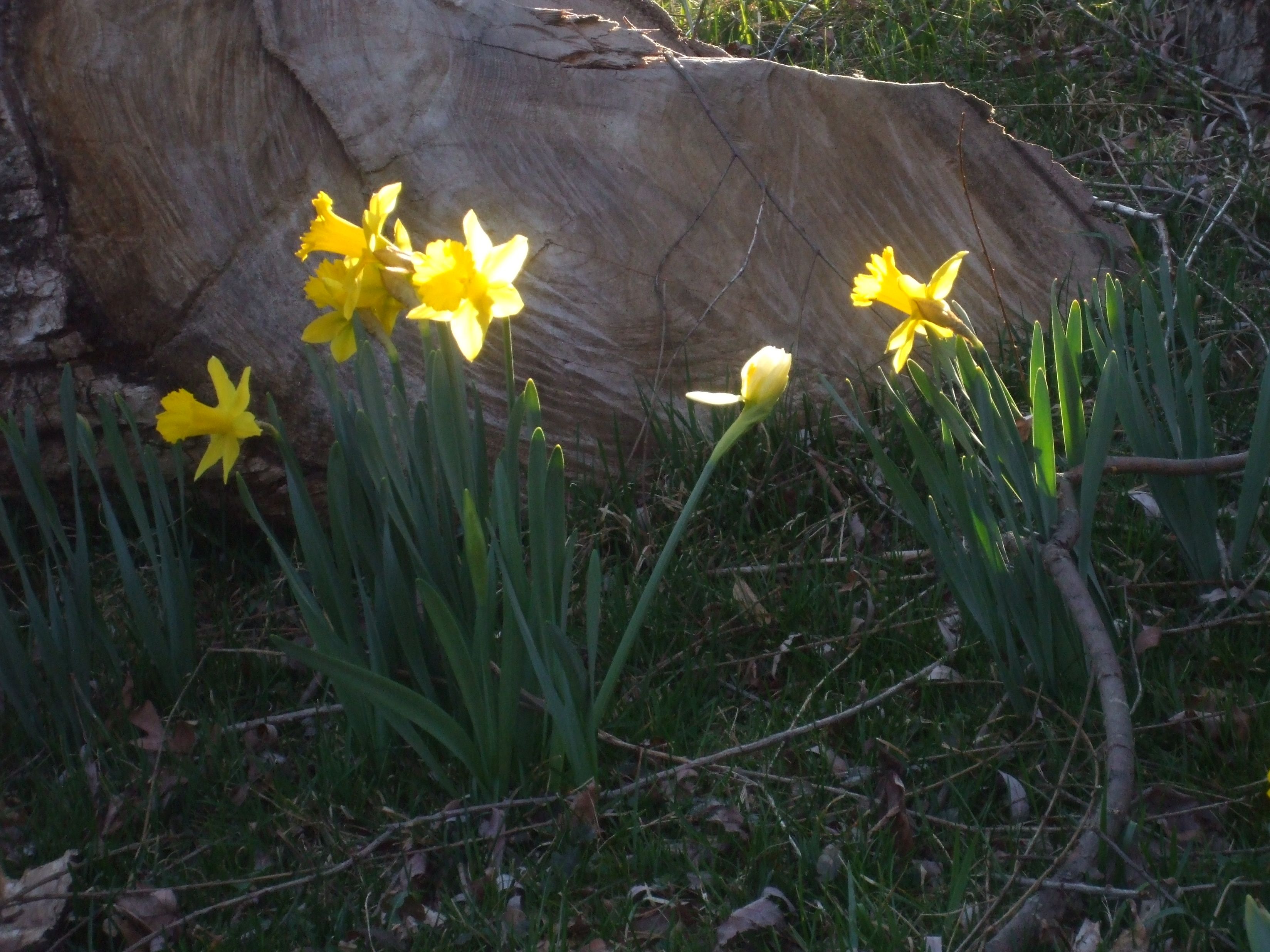
Then we have the daffodils. I was born within a day of the spring equinox, yet I don’t remember ever seeing daffodils bloom on my birthday.

Change inside. Change outside.

I was thinking about all of this when I woke up on Friday and opened my email to find this question from Seth Godin.

Did you wake up fresh today, a new start, a blank slate with resources and opportunities… or is today yet another day of living out the narrative you’ve been engaged in for years?

Funny, because with Paul’s semi-retirement, and both sons launched, and then this week re-launched, our conversations are full of ideas for changing our narrative as a couple. Where do we want to live? Where can we live? What work will we do? And what do we want to accomplish in the years ahead?

But Godin is talking about changes within ourselves, and I think his advice is particularly relevant for people who are in their fifties and sixties. As he observes,

The truth though, is that doing what you’ve been doing is going to get you what you’ve been getting. If the narrative is getting in the way, if the archetypes you’ve been modeling and the worldview you’ve been nursing no longer match the culture, the economy or your goals, something’s got to give.

… When patterns in engagements with the people around you become well-worn and ineffective, are they persistent because they have to be, or because the story demands it?

Change is everywhere. Change is hard. And creating internal climate disruption — re-examining old habits of perception and decision-making that persist because that is what we have always done — is the hardest change of all.

This isn’t about hunkering down for a session of self-blame or questioning every decision we have made since our 18th birthday. Not at all. It’s about opening the doors and windows of our mind, letting in fresh air and light, and viewing the world through a different lens.

Because when we clear away old baggage and take another look, we make room for new growth.

Wish You’d Answered JFK’s Call to Service? It’s Not Too Late!

Tags

, ,

Joining the Peace Corps when you are over 50.

Map from U.S. Department of State website

His bags are packed. In a few hours our 26-year-old son will begin his journey to Morocco as a Peace Corps volunteer.

As the minutes tick by, my husband and I are feeling a mixture of pride, excitement, and sadness—he has never lived so far away.

I also confess to a bit of jealousy. An experience like this wasn’t on my radar when I was his age.

But as it happens, the Peace Corps is not just for the young. Those of us who are old enough to remember President Kennedy’s call to service in the 1960s are still eligible to answer it—and many of us are doing just that. While the typical Peace Corps volunteer is in his or her mid- to late twenties, 7 percent of volunteers are over the age of 50.

According to Andrea Fellows, a marketing and outreach recruiter at Peace Corps, older volunteers are invaluable because they bring deep expertise to the table. “Our first goal in the countries we serve is teaching people a skill,” she says “We love seeing people who have been working in a specific field for 10- or 20-plus years because we know they will be able to do the job very, very well.”

For example, dietician Beth Payne began her service at age 62, after retiring from her career at the Department of Veterans Affairs. Payne was assigned to work at the national nutrition agency in Gambia, West Africa, where she did policy development, reviewed reports, participated in nutritional surveillance, and taught at the local university and school of public health. “The assignment was a perfect fit,” she says. “The benefit of being an older volunteer is that you don’t become a jack-of-all-trades, but rather use your specific skills.”

Adapting to What’s Not “Normal”

In addition to a strong skill set, Fellows says, you must have solid reasons for volunteering; the emotional maturity to function far away from loved ones and friends; and cultural sensitivity. That final criterion “is huge,” Fellows notes. “People have to be willing to adapt to things that aren’t ‘normal’ to them, but that may be part of the culture where they are volunteering.” A sense of service and the ability to give freely are equally important, she adds.

Fellows also emphasizes the need to have all your ducks in a row. If you own a house, for example, will there be someone who can take care of it while you are away? Do you have children and grandchildren? Someone who may graduate from college or have a baby while you are away? “You have to be prepared to miss some of those life events,” she says. (The typical term of service in the Peace Corps is 27 months.)

Consulting with loved ones before deciding to apply is crucial, say Fellows and Payne. In Payne’s case, her adult children were delighted that she would finally fulfill a lifelong dream. “They both said, ‘You talked about it all our lives. Do it,’” Payne recalls. “If you don’t have that sort of encouragement, you can fall apart pretty fast. For your peace of mind you need to know what people who matter to you think about what you are doing.”

While all Peace Corps volunteers must be in good health, the organization does try to accommodate qualified applicants who have medical issues. “There isn’t any one thing that would prevent you from serving,” says Fellows. “We try to accommodate everyone. We recently placed a person who is HIV-positive.”

Even so, volunteers must have some level of physical fitness. Because they are not allowed to drive, volunteers in more rural places may have to walk or ride a bike to get from place to place. “All the older volunteers I served with were placed in cities or villages where this wasn’t an issue,” says Fellows, who served in the Republic of Moldova.

Of Pit Latrines and Perseverance

Payne’s assignment was in a major city where she had access to public transportation, but her language training took place in a small village without running water and electricity. She said that she was nervous about her ability to use a pit latrine. “When you get older, your knees are not so great,” she says. “I had visions of squatting and not being able to get up. It took me about four days to get used to it. The anxiety was much worse than the actual event,” she laughs.

In addition to good health, perseverance is another important trait. Older volunteers, who are accustomed to feeling competent, may face a few failures. “They have to be willing to rethink, go back to the drawing board, and talk to the locals to learn how it can be done successfully,” Fellows says.

Learning a new language at an older age can be tough, and Payne is grateful that she worked in an environment where English was the official language. But Fellows insists that language should be an older volunteer’s last concern. “Our language program and support are second to none,” she asserts. “In Peace Corps they throw you into a host family and you are forced to build upon what you learn every day.”

While citizens of their host country revere older volunteers, they can sometimes find it difficult to find a support network when so many of their colleagues are in a different life stage. “Developing some sort of a sounding board the first year that I was there was far more difficult,” Payne recalls. “There was nobody my age. Once there were people who would enjoy a glass of wine with me rather than a bottle of beer, things got much better.”

Challenges aside, Payne has no regrets. “I’m so glad I finally did it!” she says. “I learned that I can be extremely flexible and go with the flow; that I’m a better teacher than I thought I was; and that I can be patient when I need to be.”

For more information, visit the Peace Corps website. In addition,  “The Peace Corps: Volunteering at Age 50+” (PDF) provides many details to help older volunteers prepare for service.

Photo from iexplore.com

Another version of this piece was published by Women’s Voices for Change under the title, “JFK’s Peace Corps Call — Wish You’d Answered it? It’s Not Too Late!”
Inside a Potter’s Studio, a Daughter Finds Answers

Tags

, , , , , , ,

A few weeks ago I hung up the phone after a brief chat with my stepmother and burst into tears. “Why so sad?” I wondered.

About to enter her 89th year, and plagued by Parkinson’s disease, it makes sense that I would be sad after hearing her faint voice leak across the wires. But I sensed that this feeling of loss went much, much deeper.

Edith married my father two years after my mother died. I was nineteen years old, a college sophomore. Although I have grown fond of her as the years have passed, I greeted her arrival in my life with ambivalence.

She was in her early fifties when she met my father, and had never been married. As a result, she was completely clueless when it came to dealing with an angry, grieving teenager. We now get along just fine, and she has been a good grandmother to my children, but the deep well of loss I felt that day was not just for her.

Then, on a wet, snowy Thursday, a new friend and I visited Elizabeth Cohen’s pottery studio.  Art was everywhere, beginning with her front steps.

These concrete leaves were made by another local artist.

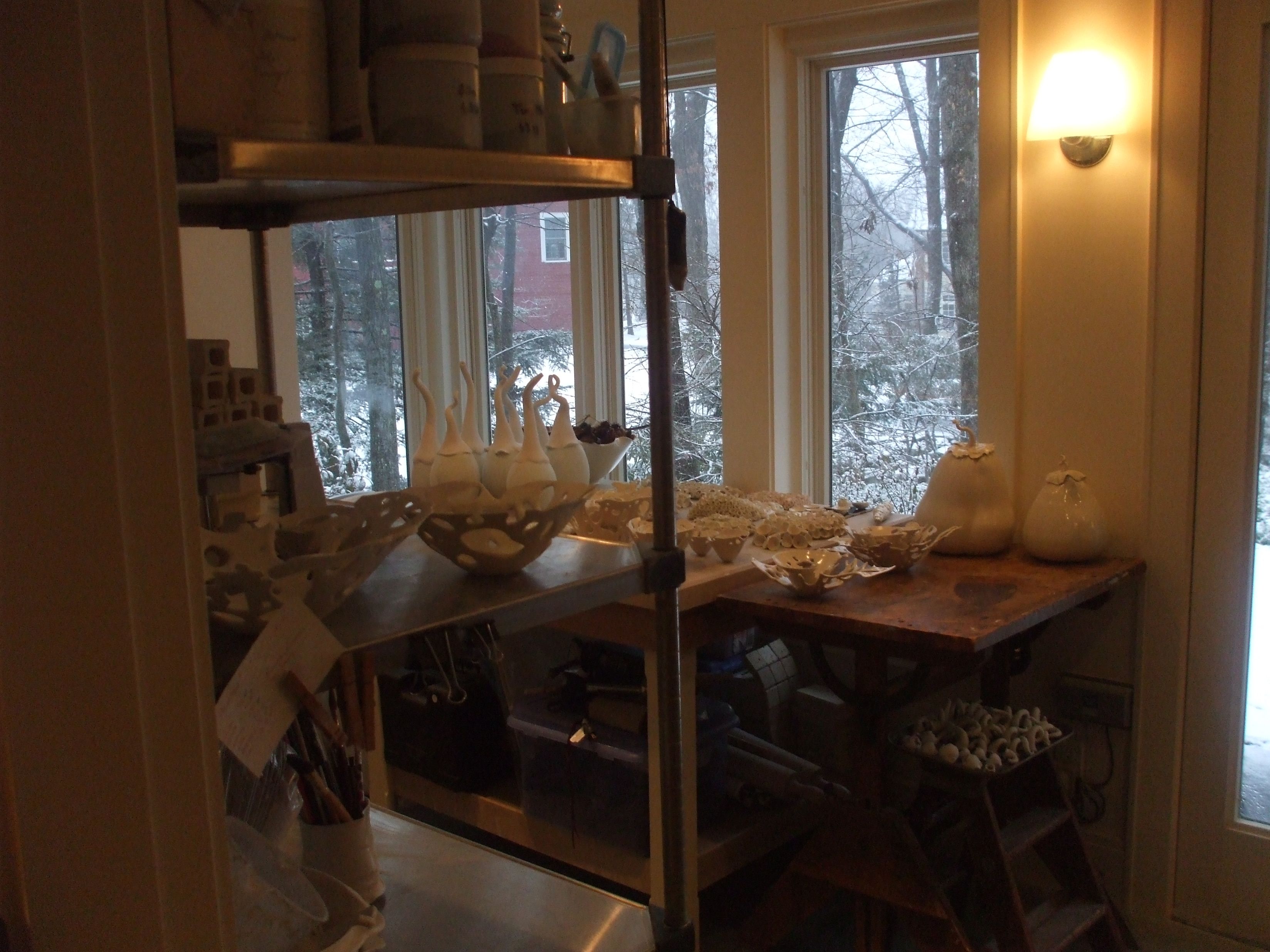
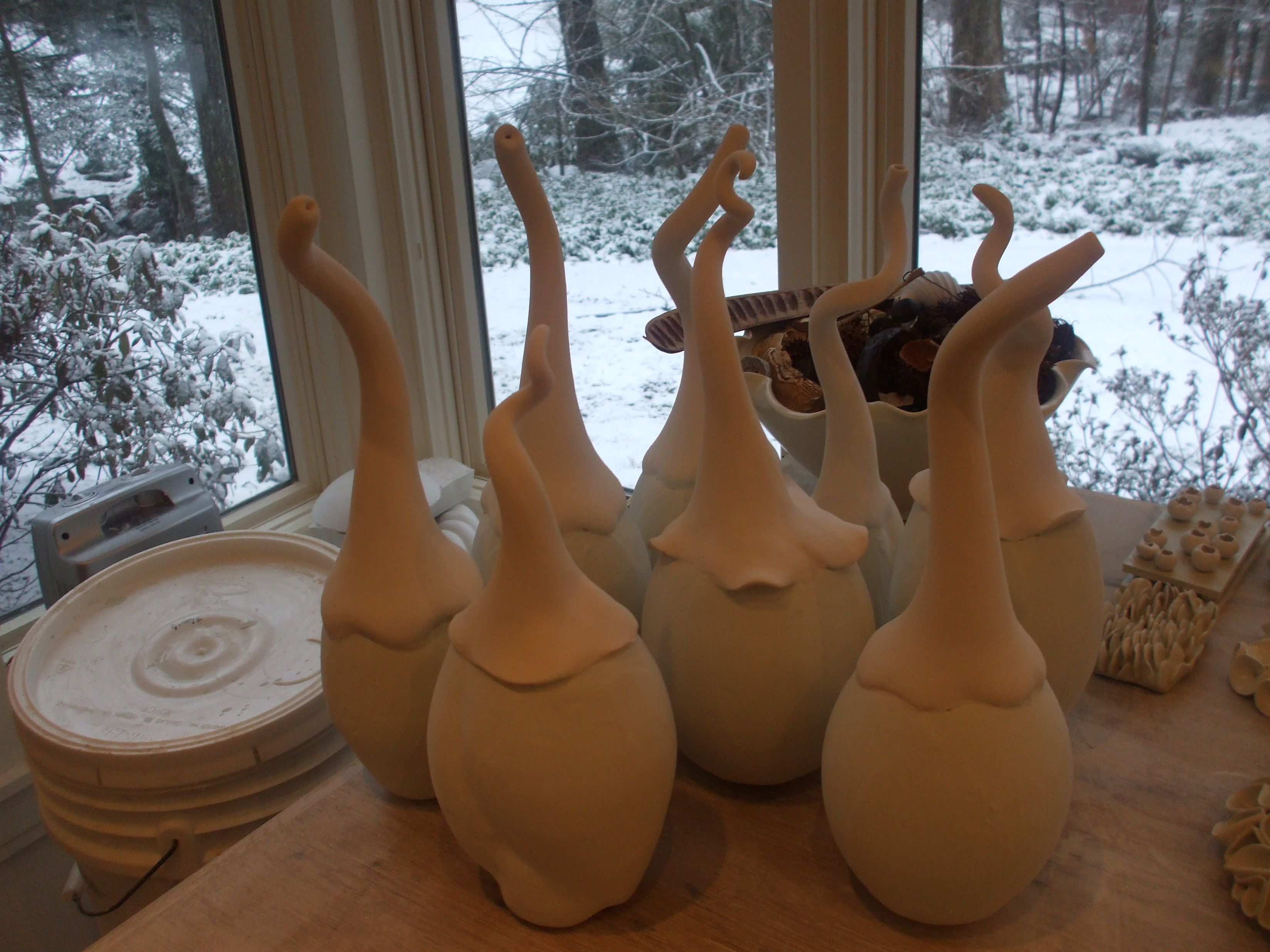
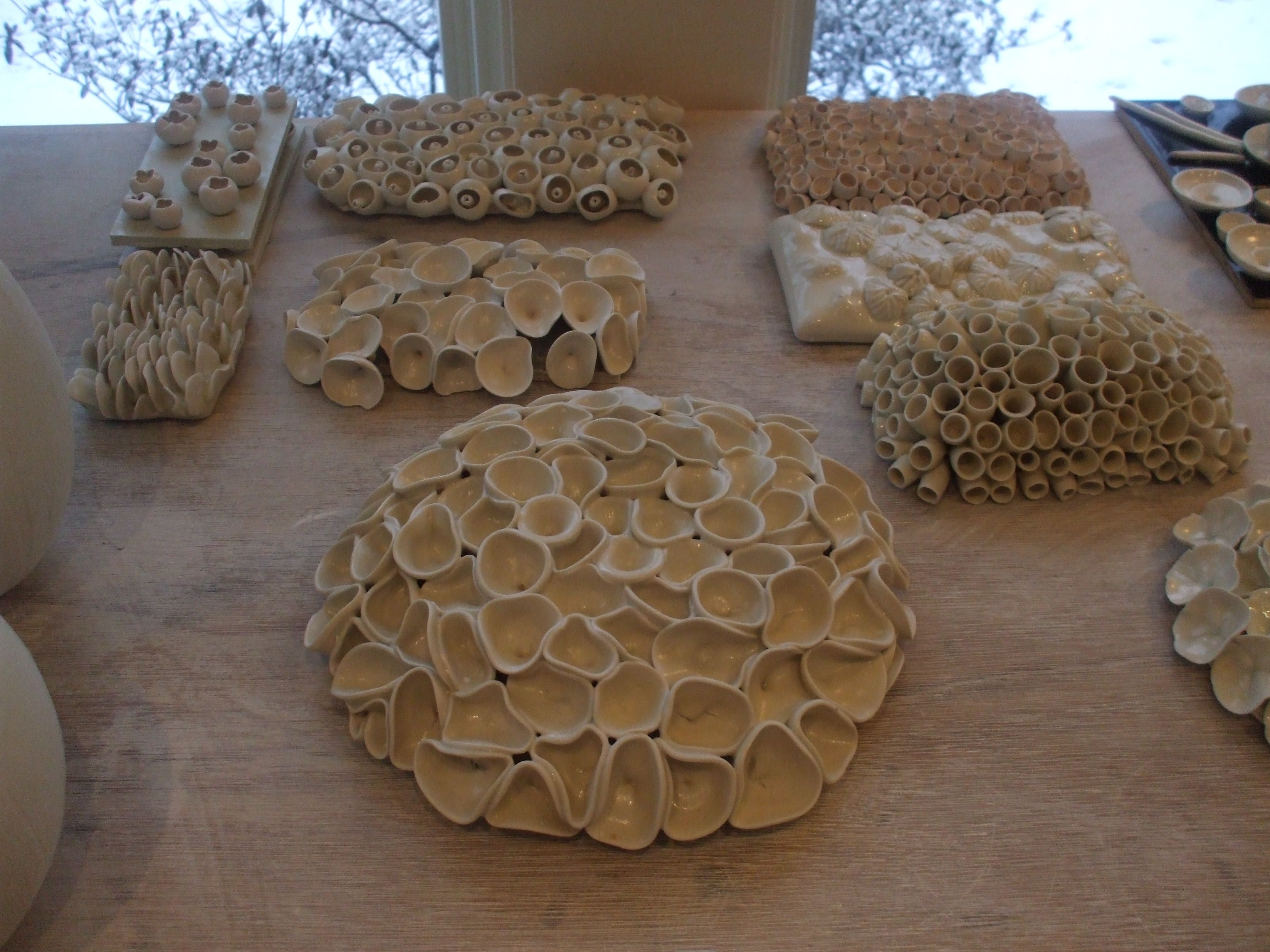
Her studio was small, but held a multitude of porcelain objects in varying shades of cream, while just outside the window the falling snow whitened the air, the trees, and the ground,

Inside the kiln.

Her mugs mold themselves right into your hands.  I now own four of them.

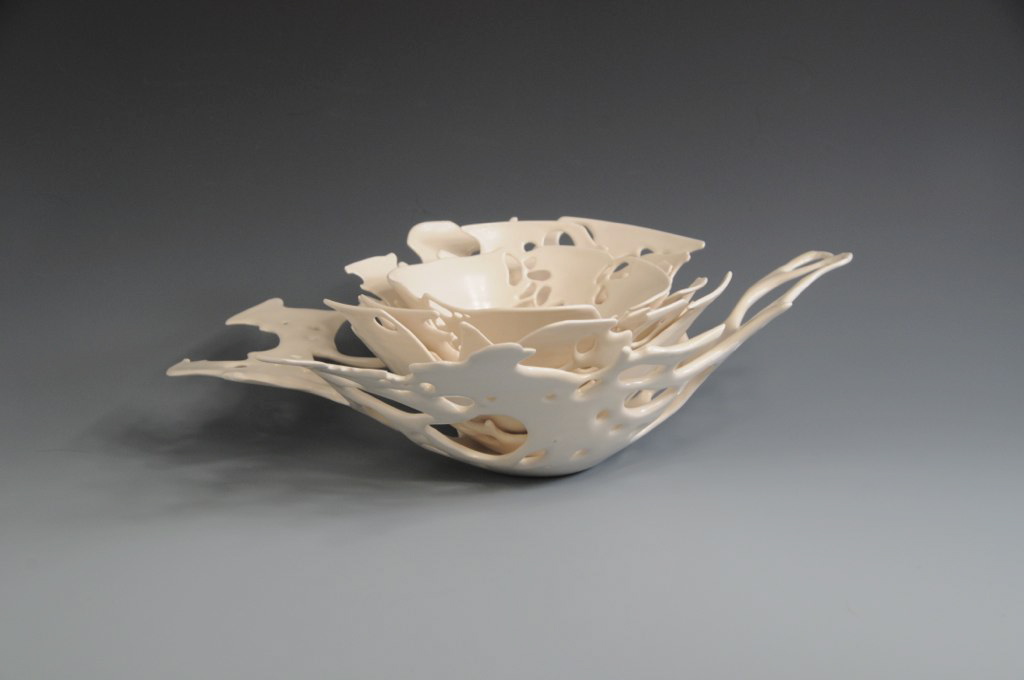
But the piece that struck me the most was a set of carved nesting bowls. It looked so fragile that I was afraid to touch it, even through my camera lens. Here’s a photo of it taken by Elizabeth.

© Elizabeth Cohen

The three of us paused over the piece while Elizabeth explained that her mother had died in the past year, and that these carved porcelain nesting bowls had been inspired by her aging bones. My friend, who is something of an expert when it comes to beautiful objects, seemed particularly taken by them.

As the snow ended, and the weekend came and went, I rolled the image of those bony bowls over and over in my mind. Eventually, it all came together, the sadness, the delicately carved porcelain — the smaller, more solid pieces nestled into the larger more porous ones.

It occurred to me, as it did when I married my husband, and birthed my children, that here was yet another event that I wouldn’t share with my mother. I’d never witness her body’s natural aging process — her bones becoming brittle, her hair turning white. She would again be absent, not there to show me the way. Indeed, I am already seven years older than she was when she died.

That’s one reason why watching my stepmother’s decline has awakened an old, old sadness. And yet, thinking back to my afternoon in that cozy studio, surrounded by white both inside and out, I know something else too.

I am not so alone. I was happy as I explored that creative nest, getting to know two other women: One my age, the other a bit younger, one who whips up confections with words, the other who does the same with clay.

I will miss my mother until the day I die, just as I’ll never stop looking for her in my family, friends, and in the new people I meet. She will be forever gone and gone too soon. But each layer of connection I make is like those bowls: I will cradle some, and others will cradle me.

Together, we will all find our way.

Joy!

Tags

,

I woke up this morning to a house and yard enveloped by heavy, white air. Rain was coming down, and the ground was covered with several inches of icy slush. It was hard not to feel as gloomy as the weather.

A walk in the woods is my antidote for gloom. In the woods the weather is almost always better. You are protected. The trees take the brunt of a cold rain or a harsh wind. And even if you do come home cold and wet, your spirits are high, and your mind is clear.

And how could that not be the case when you walk with a friend who exudes joy in every move. And you are her joy just as she is yours.

Fostering Healthy Relationships with Adult Children: An Expert Weighs In

Tags

, , ,

In my previous post, I wrote about my changing relationships with my adult children. As my son Ben, a 28-year old musician, observed in a recent email, “As we have come to understand that boundaries are different than they once were, we’ve tacitly accepted it but also had moments here and there where it has become clear that a specific boundary is different than it once was.”

And it’s in those “moments” that we parents often struggle. Should we remain silent? Should we speak up? And if we speak up, what do we say, and how do we say it?

Looking for answers, I called up Dr. Ruth Nemzoff, author of Don’t Bite Your Tongue: How to Foster Rewarding Relationships with Your Adult Children.

As you can imagine from her title, Nemzoff advocates speaking up—but with a few caveats. Here are her suggestions:

Lay the groundwork for adult conversations. One way to do that, says Nemzoff, is by sharing some of your daily dilemmas before your child leaves the nest. Annoyed at your boss, for example? Share the story.

“Often parents feel they have to be perfect in their children’s eyes or they don’t want to bother them, but children learn a great deal from our mistakes and our struggles,” says Nemzoff. “So learning that you were miffed at your boss today is an interesting thing because you stayed at the job even though you were miffed. How did you handle it? Did you blow up? Or did you talk to him or her a few days later?”

She also suggests soliciting their advice when appropriate. “Say, for example, you have a noisy coworker.  They know about that. They face it every day in the cafeteria at school.”

Invite them into solutions. Chats about real-life problem- solving can set the stage for later conversations. For example, if your college freshman, home for a holiday break, bristled over rules set in high school, Nemzoff suggests making a pre-emptive phone call before he returns in the spring.

“Think about the rough spots and then talk about them on the phone,” she says. “Perhaps a rough spot was when you asked, ‘What time are you coming home?’ You can acknowledge that at college no one’s asking that, but explain that as his mother, you can’t just turn it off. Perhaps instead you can ask, ‘At what time should I start to worry?’”

“You have to be flexible, but so does he,” Nemzoff adds. “He has to understand that things have changed for you, too, and that you may not be as available as you were when he lived at home full-time.”

Choose your battles. As much as parents don’t want to feel silenced, they can opt to not say anything. “Being silenced by someone else is very different from deciding to be silent,” says Nemzoff. If your adult child’s behavior isn’t harming anyone, then perhaps you should remain silent and save your advice for another time, she suggests. Nemzoff also recommends couching the advice you do give as just one perspective, suggesting that your children seek other opinions as well.

Use the same communication skills you employ with others.  As with anyone, timing, tone, and environment all matter when initiating an important conversation with your adult child. You wouldn’t ask your boss for a raise after making a big mistake, any more than you would loudly demand a raise in a public place.

“We fantasize that we can say anything we want to our kids, but the truth is, we never could,” Nemzoff says.  “When I’m babysitting my grandson I don’t tell him that we are going to the circus while I’m putting him in bed. He’d never get to sleep!”
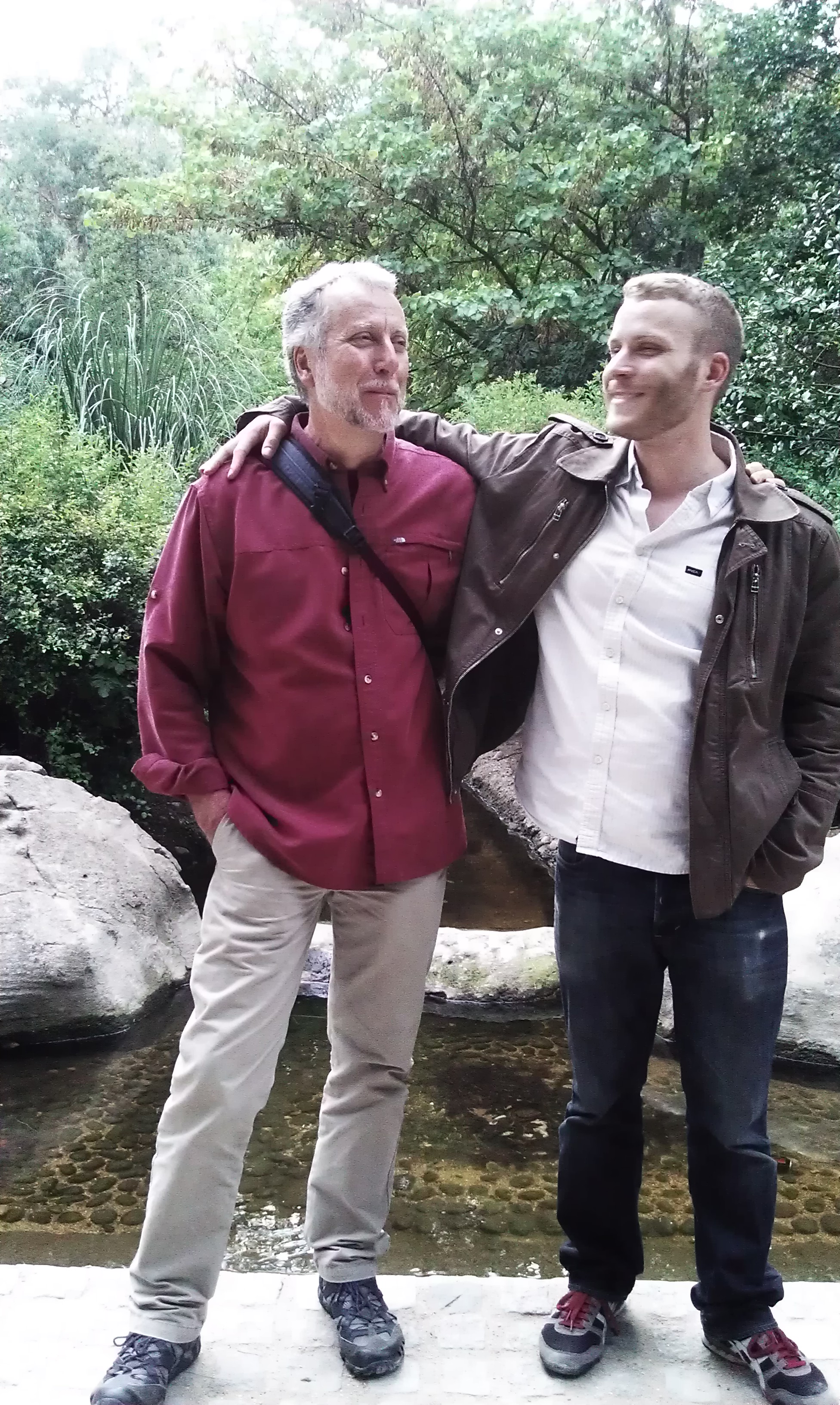
Maintaining open communications with our children is endlessly challenging, but ultimately rewarding. And, as Ben notes, always evolving.

“Gradually coming to see your parents as equals, or at least equally human, is a big one. While the first 18 to 22 years of my life were spent as the focus of care and attention while I faced various transitions, I now find myself somewhat stable, while my parents are wrestling with major changes to the life that they’ve had over the last thirty years. Seeing this has led me to understand our relationship as being co-equal in certain ways. For example, as a freelancer in a creative field undergoing major changes due to the Internet, I can trade ideas and commiserate with my mom’s journey as a writer.”

In addition to Nemzoff’s book, I also recommend this essay by writer Dominique Browning, which contains valuable tips for planning a vacation with adult children. In retrospect, if my husband and I had followed Browning’s first rule, “Turn it over to a younger power,” our Paris trip would have gone much more smoothly.

(photo by Paul Syversen)

This piece was originally posted on Women’s Voices for Change. 

Family, Dynamic

Tags

, ,

A dozen years or so ago, my husband and I were sipping coffee at an outdoor cafe in Harvard Square. Seated one table away was what we assumed to be a college student with his visiting parents. We could overhear the low babble and occasional laughter of what sounded like an easy conversation.

“I hope we get that with our guys,” I commented. “I certainly never had it with my parents.” Indeed, neither of us had. I lost my mother at age 17 and was left with a father who was unable to sit still for any normal conversation, while Paul’s parents lived several states away, and visits with them were rare.

Our two sons, who were in high school when we had that exchange, are now well into their twenties. And we have enjoyed numerous meals and lively conversations with them. For the most part, our adult sons seem to enjoy spending time with us.

So I was taken by surprise last summer when things went awry during a family vacation in Europe. The trip started out happily enough with a family wedding in Italy. But after we left for France, things started to go haywire.

Each of us was in the throes of a major transition. My husband and I were adjusting to his retirement the month before. Older Son joined us on the heels of completing an intense project —a concert tour with his trio that as “band mom” he had organized and led after a year of planning. And Younger Son was in limbo, awaiting final word on his Peace Corps assignment.

We were all making huge changes, and while we didn’t know it, our relationships with each other were changing too. There were squabbles and showdowns the likes of which we hadn’t experienced since the boys were teenagers. In fact, I felt as though the ride from Florence to Paris took place in a time machine, rather than on a train.

View from inside the time capsule

For one thing, our sons were no longer willing to sit back and let Dad lead the way. With three leaders and only one follower, it took us forever to get anywhere. Finally, Younger Son grabbed my husband’s GPS and laid down the law. “I know what I’m doing, Dad. Let me lead.”  And Older Son, who had been riding the Paris subways for a couple of weeks by this time, had his own ideas about which trains we should take.

What do you mean I'm supposed to follow you?

And Dad wasn’t the only one being chastised, I was in for some critiquing too, and unlike my husband, I let it get to me. I will always remember this trip as the one where I walked around Paris with a constant lump in my throat and tears in my eyes. My children didn’t need me — did they even like me? —and there was nothing I could do about it.

Alone in Paris (photo by Paul Syversen)

Except that there was. After a serious talk with one son, and a loud argument with the other (I yelled), and some time apart, we did manage to come together and enjoy each other’s company. But I know I wasn’t the only one heading home with this equation in my head: family+ vacation = oxymoron.

Then, Christmas rolled around, and something had changed again. One son suggested that we each cook a dish or two for the family dinner. Everyone liked the idea and my husband and I were thrilled to share that responsibility.

The transformational moment arrived when the two young men came back from buying ingredients at the grocery store, and neither of them handed us a receipt. Clearly, they were taking full ownership for their portion of the meal. Although we haven’t supported either of them financially for some time, in that moment something changed. I saw them more clearly as equals and Paul and I were no longer just parents, but people too. The resulting feast was especially delicious.

I now know that as tough as that Paris trip was, it helped us all move forward. I realized (and I hope we all did) that the four of us have to keep talking and listening, and that sometimes the most difficult conversations are also the most rewarding.

I’ve also discovered that my relationship with my adult children will always require tweaking and even major adjustments. And though I advocate initiating difficult conversations, there are ways to handle them that don’t involve yelling — or even tears.

Equal

In my next post, I consult with an expert.

***

This piece was originally posted on Women’s Voices for Change.

Daily Walk

Tags

, , , ,

It’s been a quiet week here. Lots of changes in the wind. Lots of ideas percolating for this blog. One thing I’ve wanted to share for a long time is my daily walk.

Just down the street from my house is a trail that takes me into the town woods — affectionately known as Fairyland.

(For a better view, click on each photo.)

Entrance to Fairyland

It’s not so easy, however, to take photos while keeping tabs on a busy puppy. My husband, Paul, joined us yesterday, leaving my hands free to hold a camera.

Entering the birch grove.

The trail is marked with quotes by Henry David Thoreau, who once wandered these woods.

Thoreau's reflection on the white birch

No wonder, then, that the white birch is so prevalent and characteristic a tree with us and that the seedling birches spring up every year on so many neglected spots, but especially where the surface has been cleared or burned.

And there are other markers and whimsy as we wander down the trail.

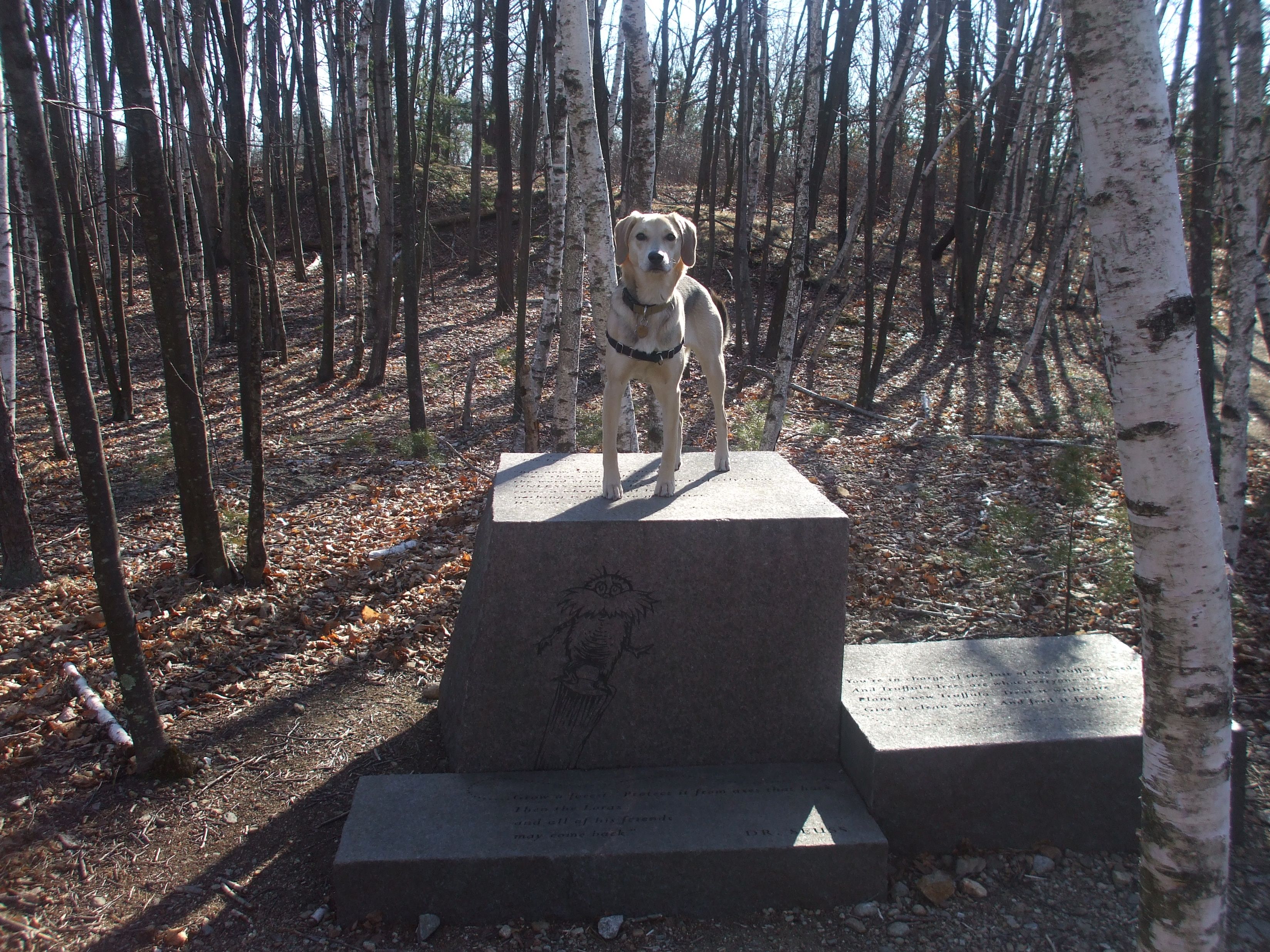
Karina communes with the Lorax

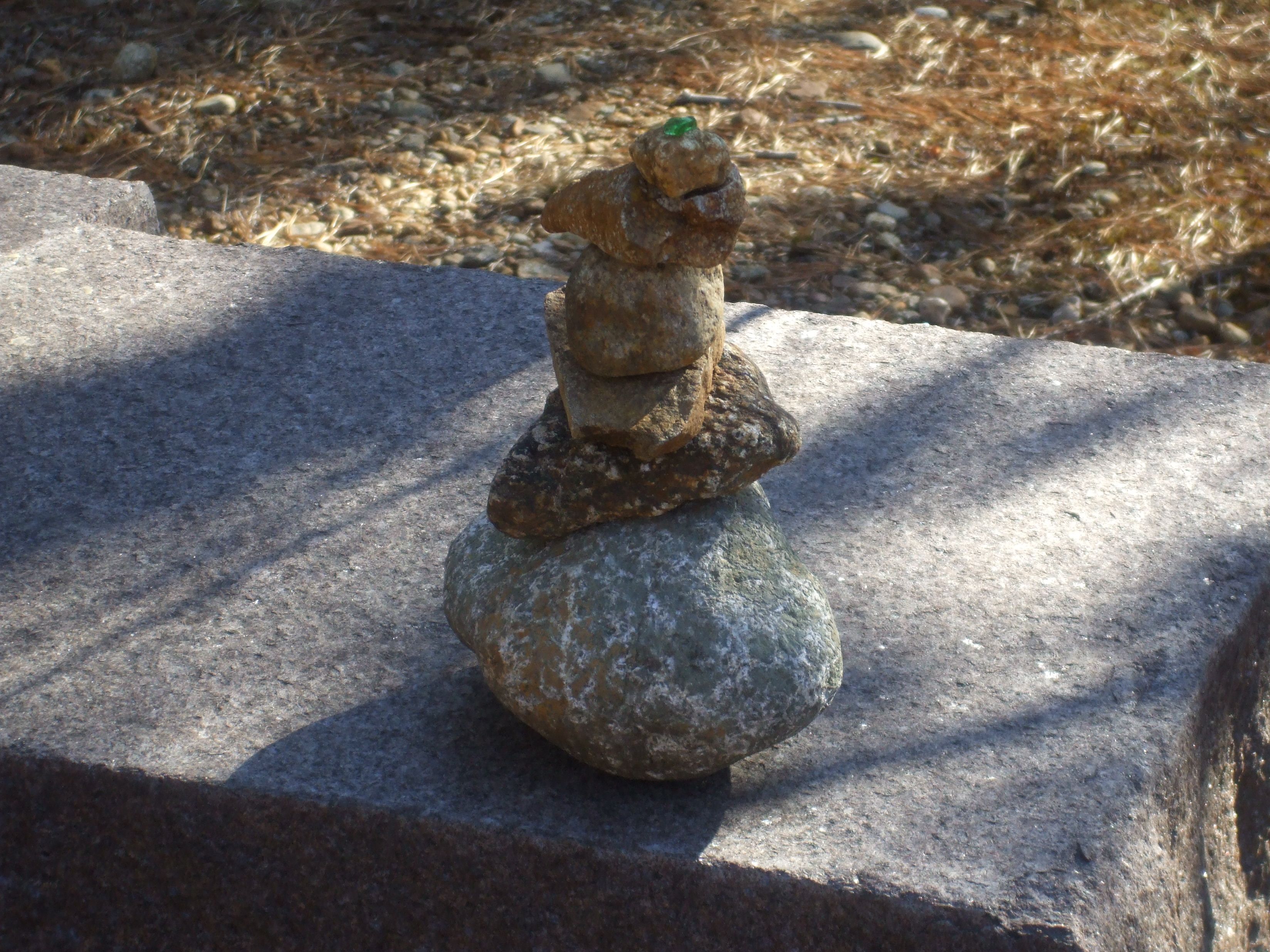
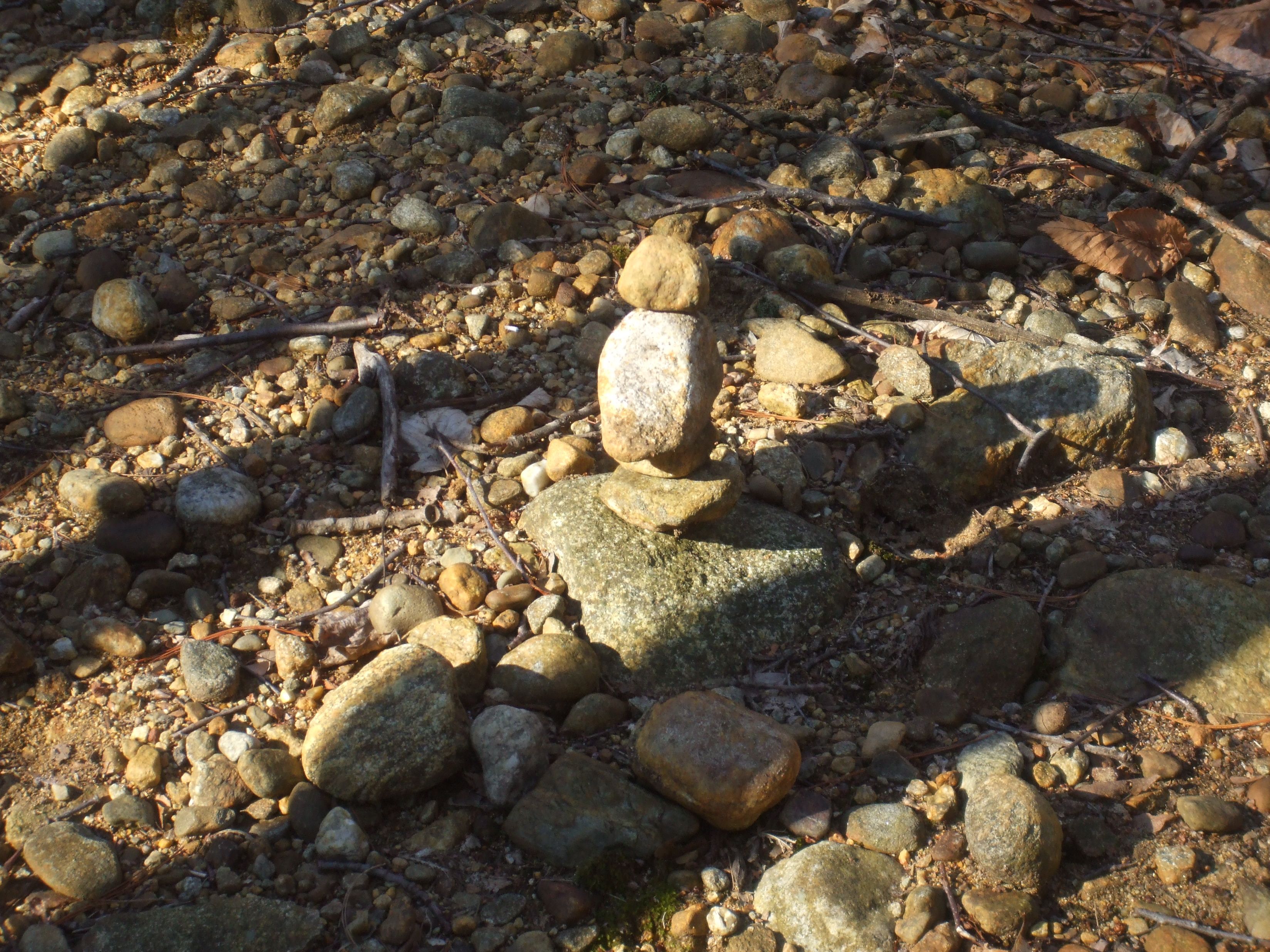
And totems big and small left by fellow wanderers.

Bejeweled rock pile

Trail guard

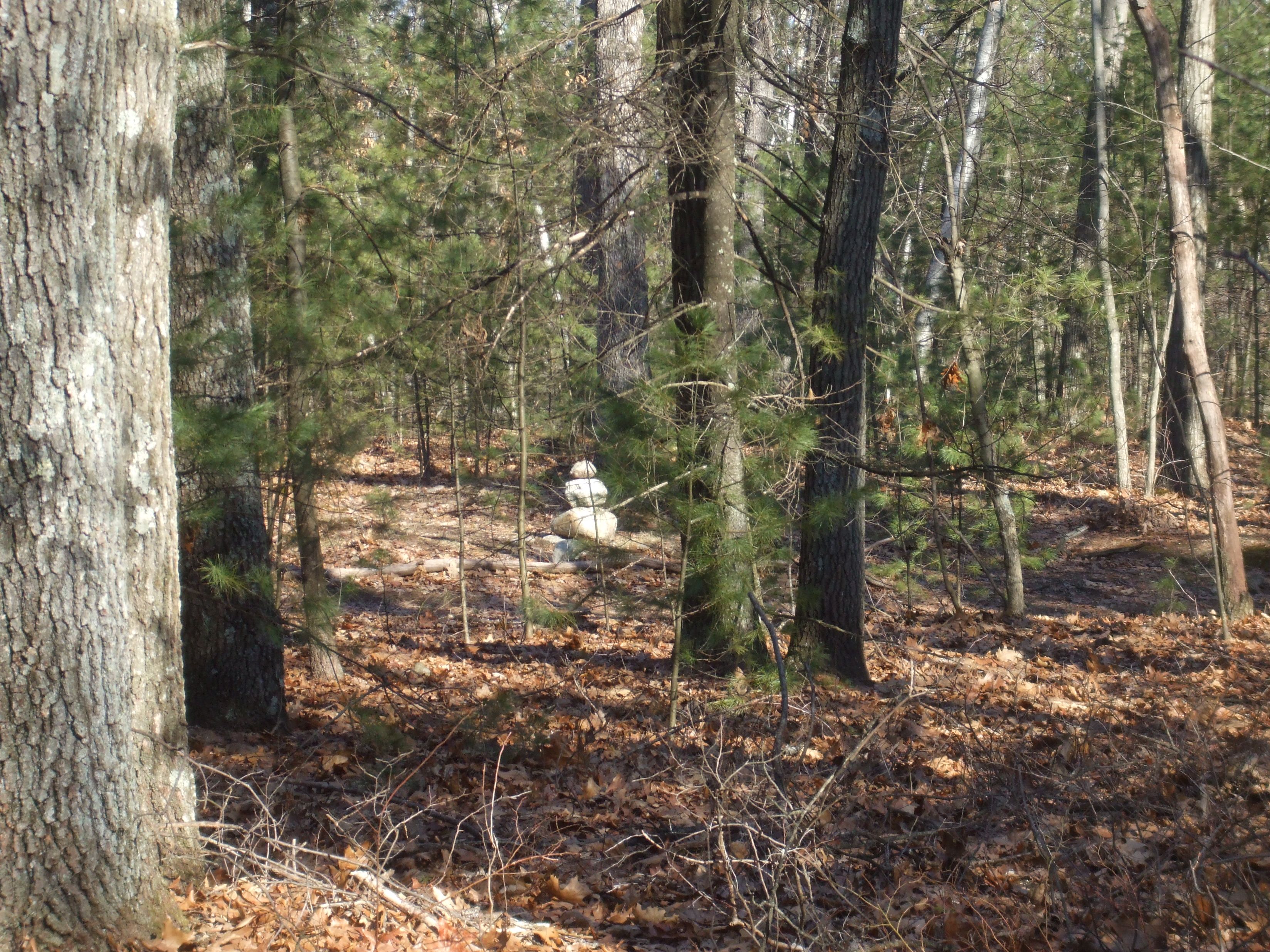
And this large rock pile seen through the trees. From this angle, it reminds me of a snowman in what so far has been an almost snowless winter.  For years it has been knocked down and replaced with amazing regularity. One early morning my dearly departed Hobbes and I came across its maker sitting next to it with his dog. I was too shy to ask him what he was doing.

Old totem at the crossroads.

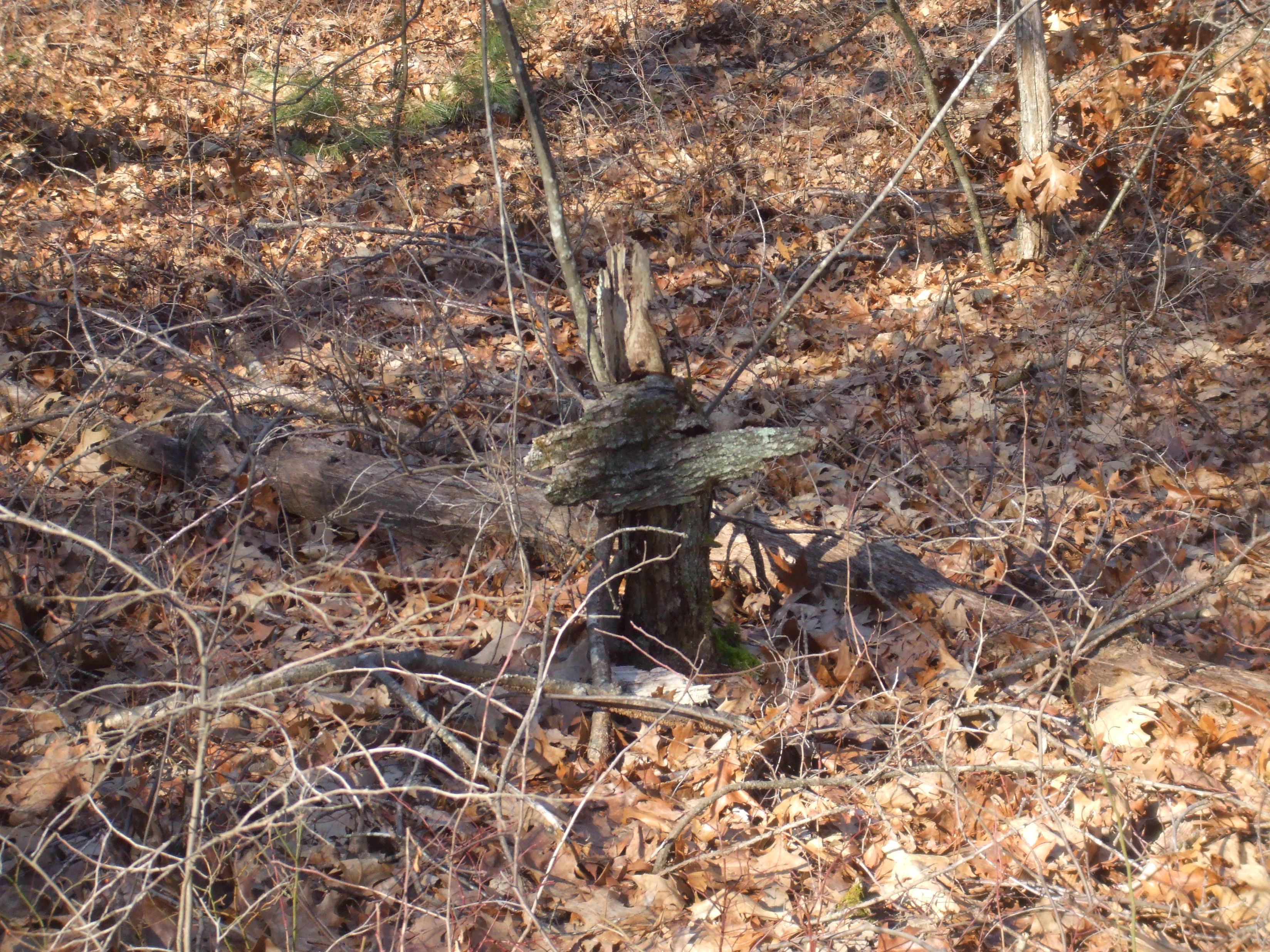
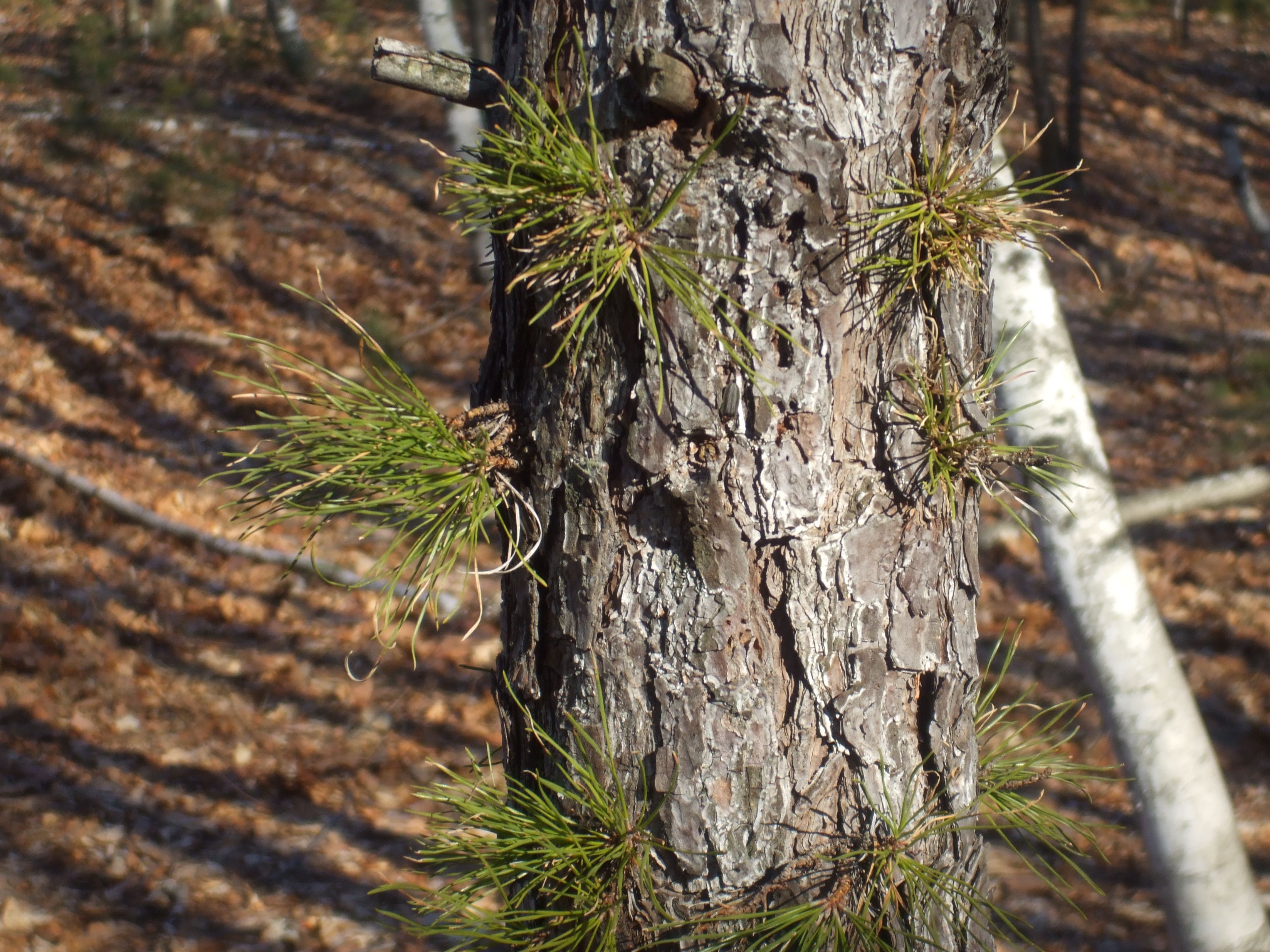
But my favorite totems are made by Mother Nature.

Cross in the woods

Fairy steps

New needles

Karina and I start every day this way. Thanks for joining us!

All walked out