• About Judith A. Ross

Shifting Gears

Shifting Gears

Category Archives: health

Pink + Green = Breast Cancer Prevention

22 Monday Oct 2012

Posted by judithar321 in environment, health, politics

≈ 3 Comments

Tags

breast cancer awareness month, breast cancer prevention, carcinogens, Moms Clean Air Force, pink ribbons, Rachel Carson, Silent Spring

October is breast cancer awareness month. Pink ribbons are everywhere, from lapels and teddy bears, to cleaning products and perfume. So much levity and cheeriness for a disease that is deadly seriousness.* So much hypocrisy when these ribbons adorn items containing carcinogens.

When I think about breast cancer, I think about my mother, who died of it at the age of 50. I think of my own diagnosis 22 years later. And, I think of the women I encountered in the waiting room during treatments, and the many I’ve spoken to since, who unlike me, had no genetic risk factors and yet, just like me, were diagnosed with the disease at a relatively early age.

Why them? For that matter, why me? Why are so many of us being stricken?

Some of the answers can be found in a small, green paperback that my father presented to me a few months after my mother died.

Silent Spring by Rachel Carson was published fifty years ago last month and is often credited with igniting the environmental movement. Carson addressed her widely-read book to the general public. It clearly explains how man-made chemicals used to kill insects, weeds, rodents, and other such pests, can travel up the food chain and impact human health.

She asked:

Can anyone believe it is possible to lay down such a barrage of poisons on the surface of the earth without making it unfit for all life?

Carson also sounded the alarm back then for how these poisons can change us on a cellular level.

Some would-be architects of our future look toward a time when it will be possible to alter the human germ plasm by design. But we may easily be doing so now by inadvertence, for many chemicals, like radiation, bring about gene mutations. It is ironic to think that man might determine his own future by something so seemingly trivial as the choice of an insect spray.

Carson wrote these words in the midst of her own battle with metastatic breast cancer. She died two years after Silent Spring was published. Her wise and prescient voice silenced, just like the spring she envisioned in her book’s opening pages.

So while I applaud organizations that use pink ribbons to raise money for breast cancer research, I also agree with my fellow blogger, Elisa Batista, who says,

“It will be a good day when pink mixes with green.” 

To hasten that day, we must honor Rachel Carson’s legacy by educating others about the environmental causes of breast cancer. For the sake of our daughters and our sons (yes, men get breast cancer too), we must take action now.

And we shouldn’t rest until we pin the last pink ribbon on the lapel of the last corporate polluter, and send them packing.

***

This post was originally published by Moms Clean Air Force

* To better understand why so many of us resent the girly, pink symbolism associated with breast cancer, check out this terrific post by Erika Lade.


Women Who Dare

10 Wednesday Oct 2012

Posted by judithar321 in health, pets, politics, work, writing

≈ 12 Comments

Tags

Betty Ford, breast cancer awareness month, Brené Brown, cancer, courage, Lynn Povich, Newsweek, Suleika Jaouad, The Good Girls Revolt, universal healthcare

What is courage?

According to Merriam Webster’s Collegiate Dictionary, Tenth Edition, it is “mental or moral strength to venture, persevere, and withstand danger, fear, or difficulty.” Courage, in other words, is volunteering to venture outside of your personal safety zone and stay there, come what may.

In her TED talk exploring human connection, researcher and storyteller Brené Brown reminds us that the word courage is rooted in cuer or heart, and the original definition is “…. the willingness to tell the story of who you are with your whole heart.” It’s the willingness, she says,  “… to be imperfect.”

According to Brown, that kind of courage allows us to make human connections, because connection requires authenticity. She found that the people she studied who felt a strong sense of love and belonging, “… were willing to let go of who they thought they should be, in order to be who they were.”

Courage has been on my mind these past weeks. I first started thinking about it while preparing to review The Good Girls Revolt: How the Women of Newsweek Sued Their Bosses and Changed the Workplace by Lynn Povich.

Povich provides a candid, step-by-step account of how in 1970, she and 45 other women working at Newsweek had the courage to be who they were, rather than who they thought they should be. These women shed their “good girl” upbringing, spoke up, defied the boss, and charged the magazine with discrimination in hiring and promotion.

The book reminds us that there is no such thing as “post-feminist” and that backsliding is easy, while forward progress is difficult, and the battle for equality and fairness must be fought over and over again. Today’s war on women and attempts to suppress the vote are certainly evidence of that.

And because October is breast cancer awareness month, First Lady Betty Ford has also been on my mind.

Ford exhibited enormous courage when she went against the culture of the time and publicized her own breast cancer diagnosis and treatment in 1974. My mother died of the disease in 1972, too soon to benefit from Ford’s candor, but twenty years later, her honesty helped me.

Instead of the whispered conversations I overheard as a teen when my mom was diagnosed, I talked openly with my two young sons about my own diagnosis and treatment. Sure, I was afraid. Terrified, in fact, that they would experience the same devastating loss that I had. That they, too, would be forced to learn how to live without a mother.

But because Ford was willing to shine a bright light on her own journey, as unpleasant, painful, and embarrassing as that may have been, it was much easier for me to talk about my illness with others. And though I often felt isolated during that time, I never felt alone.

Another woman who is taking the power by publicly discussing her experience with cancer is 24-year-old Suleika Jaouad. I have been following Jaouad’s New York Times column, “Life Interrupted,” for several months. She wisely and eloquently conveys what it’s like to grapple with a life-threatening disease while at the very beginning of independent adulthood.

Jaouad doesn’t mince words when it comes to the tough realities she faces. If, for instance, you have any doubts about the need for universal healthcare, perhaps her column on the topic will convince you.

Although Jaouad writes about her experience as a young adult with cancer, much of what she shares will resonate with anyone who has had the disease.

For example, this photo she posted on@SuleikaJaouad, reminds me of how victorious I felt when I brought home my first puppy one year after completing nine months of breast cancer treatments.

Photo by Seamus McKiernen, used with permission.

Seeing her with her new puppy reawakened the sense of urgency I felt both during and after my treatments: I’d better get that dog, take those trips, and give that child what he needs. Now.

Just like Betty Ford, Jaouad’s willingness to share who she is and what she is going through will connect her with and make a difference to those who read her words for decades to come.

Povich et al., Ford, and Jaouad, all exhibit Merriam Webster’s definition of courage — they all were willing to step out of their personal safety zones and stay there. As a result, they all have helped make the world a fairer and more accepting place.

But by also fulfilling the original definition of courage —the willingness to be imperfect, to tell their story with their whole heart — they connect with the rest of us in a deeper, more meaningful way. By opening the door so we can see ourselves in their struggles, they invite us to care and to join them. It’s a kind of courage that we can all aim for.

According to Brown, those who feel worthy of connection are not afraid to show their fullest, truest selves because they believe that what makes us vulnerable, makes us beautiful.

It makes us powerful, too.

Why I Buy Organic Food

05 Wednesday Sep 2012

Posted by judithar321 in environment, health, inspiration, writing

≈ 8 Comments

Tags

Hutchins Farm, Journalism, organic food

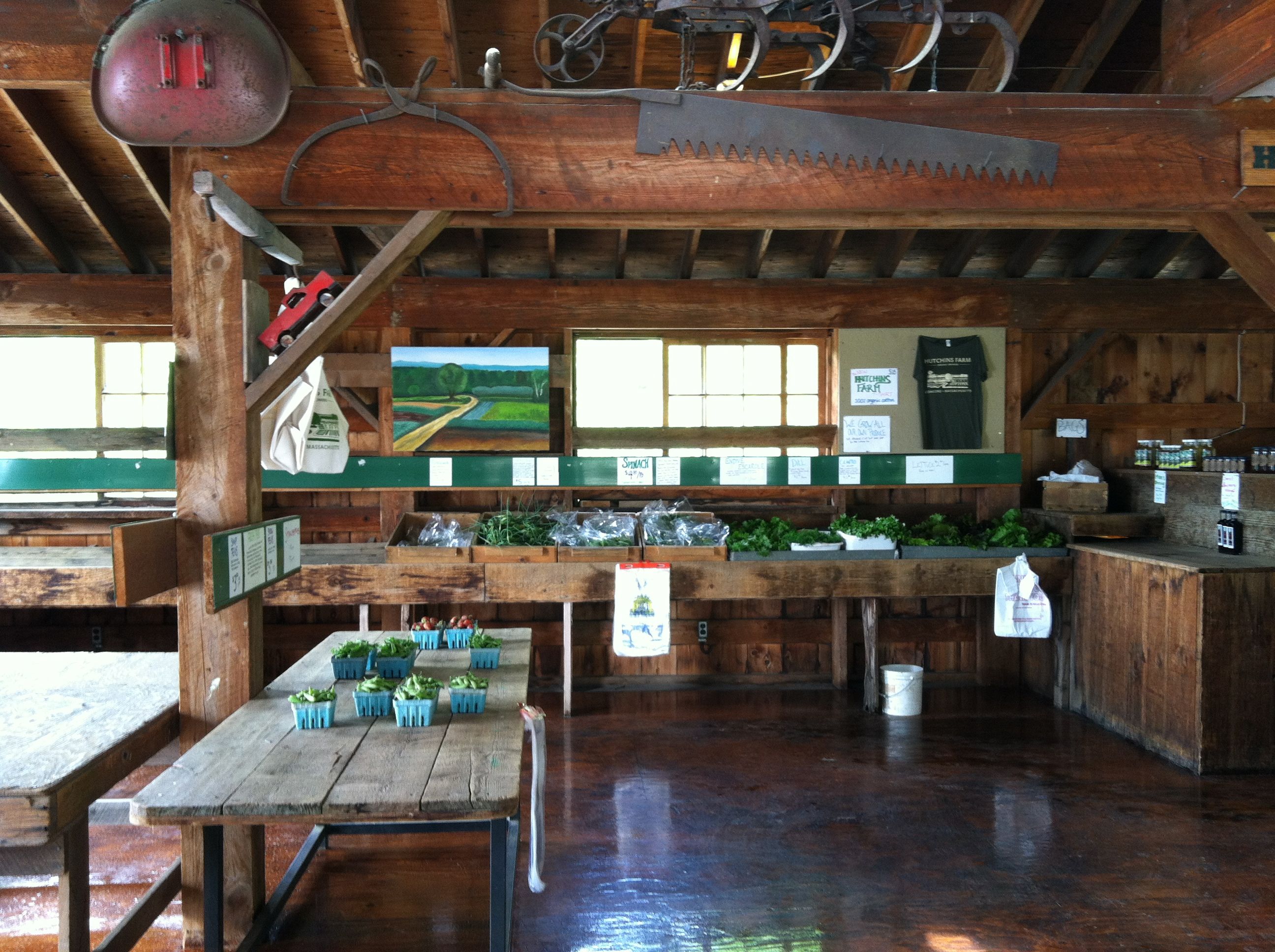
Every spring we wait in breathless anticipation for our local organic farm to open. In late May, the bounty starts to roll in, beginning with lettuce, arugula, and spinach.

By late June we start to see strawberries, and as the season progresses, the shelves become more and more crowded with gorgeous, local produce.

Meet Liza Bemis, my local organic farmer.

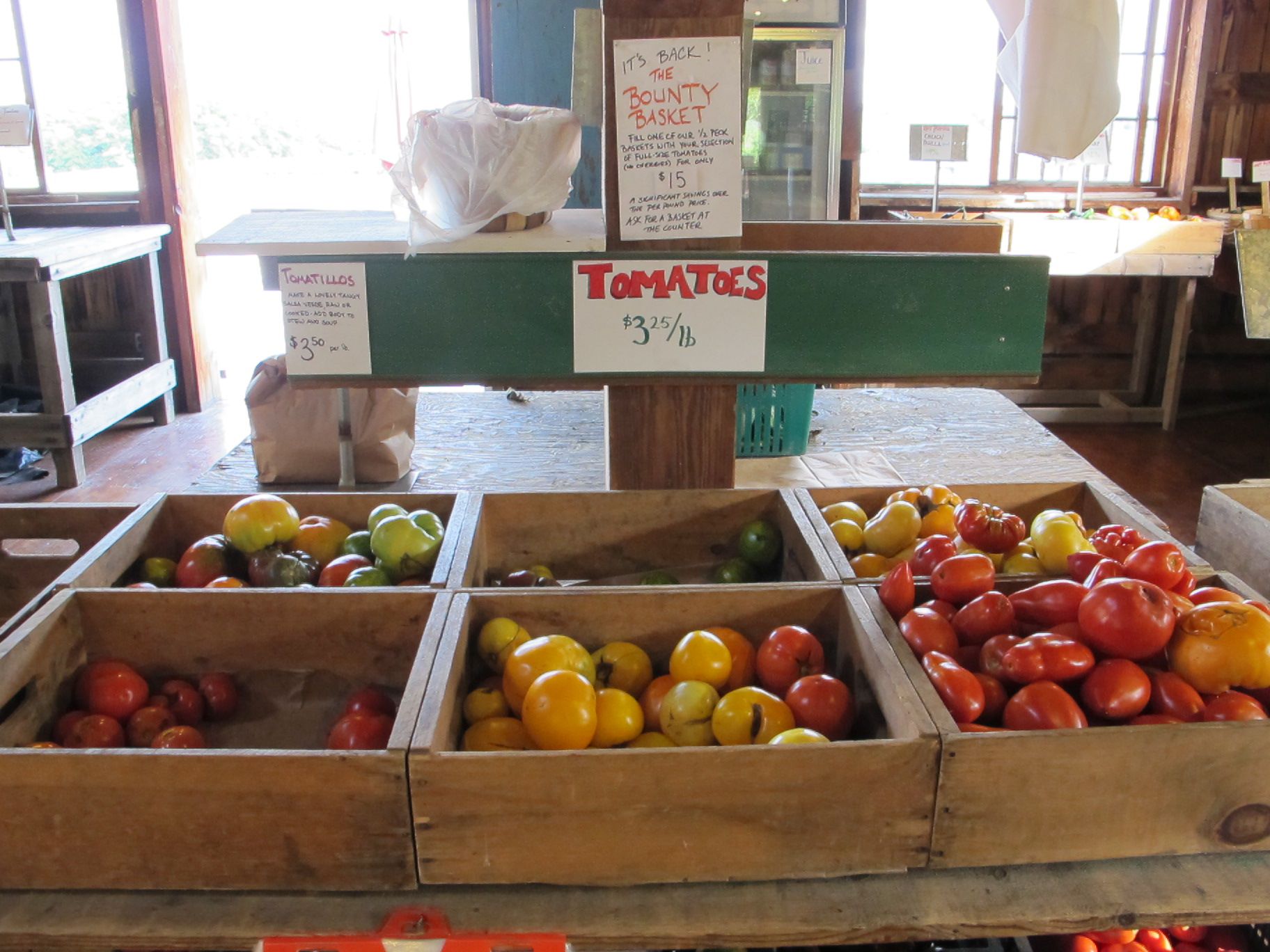
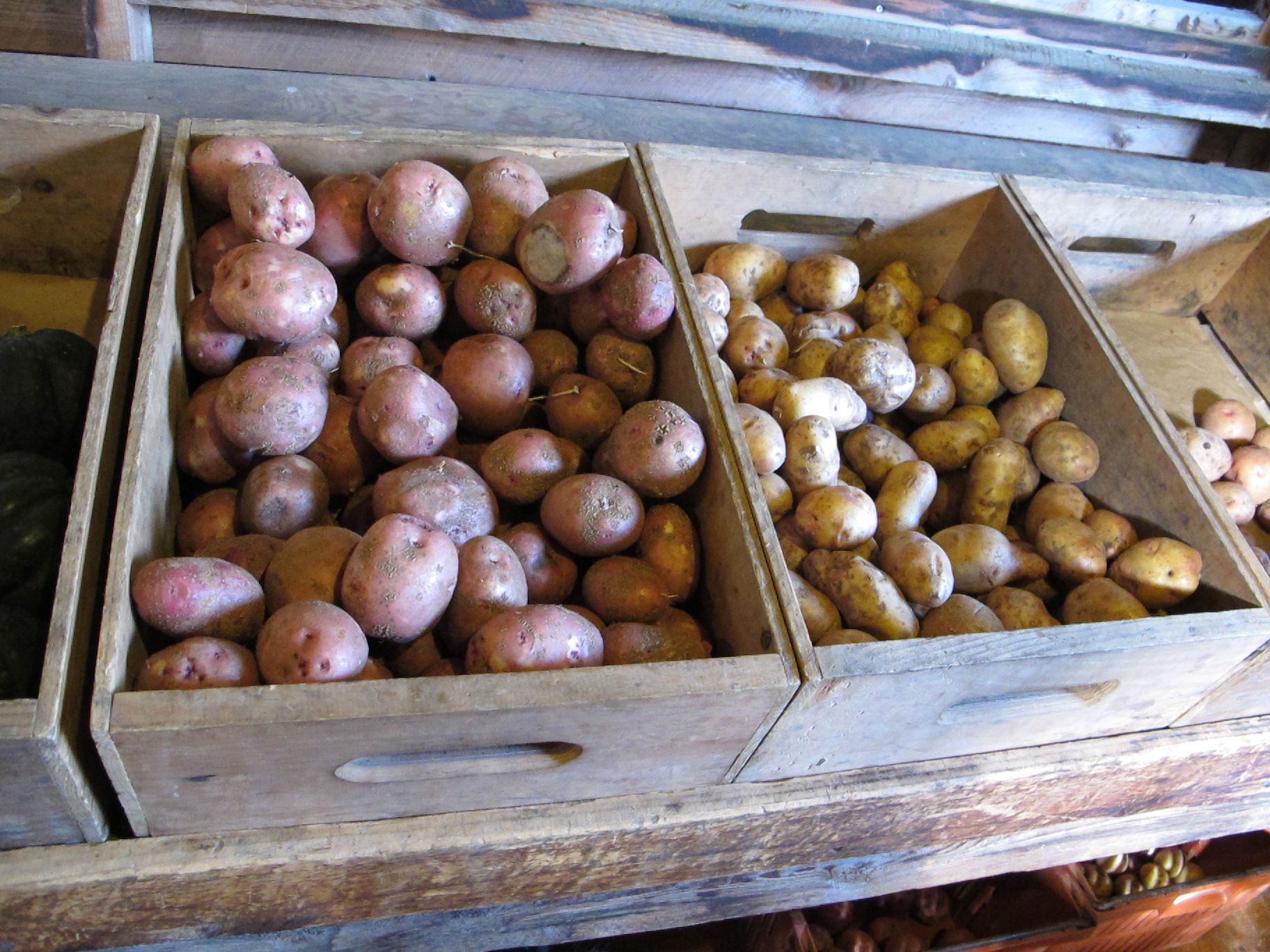
Now that it’s September, watermelons are on the wane, tomatoes are still in full swing, potatoes are coming in, and squash is beginning to fill up the bins outside.

There is nothing more tasty than a roasted potato that was pulled out of the ground that very morning.

I love my local organic farm.

So when I saw “Organic Food Benefits Doubted,” trumpeted in the index on the front page of yesterday’s New York Times, my blood began to boil. The article, prominently placed in the front section under National News, did nothing to calm my ire, “Stanford Scientists Cast Doubt on Advantages of Organic Meat and Produce.” 

Both headlines were deceptive. The study found that organic meat and produce are no more nutritious than conventionally grown meat and produce. But that’s not why I buy organic food.

I buy organic food because it isn’t grown with pesticides or injected with hormones. And because organic farmers don’t use pesticides and other chemicals, they aren’t harming the environment. According to Liza, that’s the reason organic farmers do what they do.

They love growing healthy food, and they respect where it comes from.

“P.S. Today Is One Hot Scortcher.”

19 Thursday Jul 2012

Posted by judithar321 in environment, health, mid-life transition, politics

≈ 4 Comments

Tags

Catherine Tumber, climate change, fishing, grandchildren, grandparents, heat wave, humidity, letters from home, Moms Clean Air Force

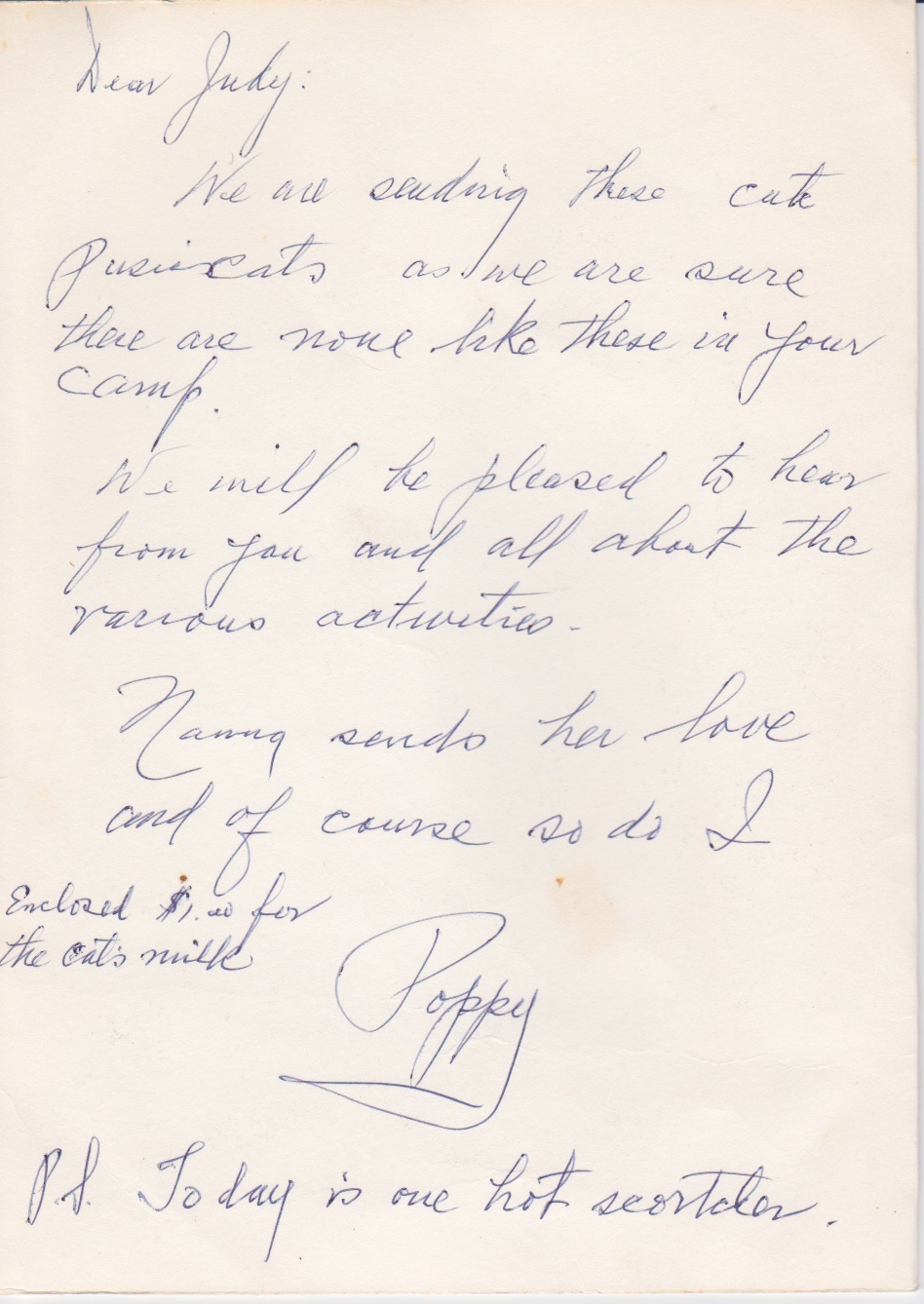
The spelling is imperfect, but the card and note inside are priceless. My grandfather sent the card to me while I was away at overnight camp. Somehow, I have managed to hold onto it and other letters from home (more about those in another post) throughout several moves and numerous decades.

But my Poppy’s P.S. on this card comes to mind whenever we have a heat wave.

Other than his interesting spelling — which I’m just now noticing — I am also focusing on his choice of words, especially the word “one.” Back in the early- to mid- 1960s when the card was sent, we’d have the occasional oppressive day here in the Boston area — a real scorcher. It almost always cooled down at night and the extreme heat rarely lasted more than a day or two.

This week has been one of several this summer when we’ve had a whole string of days with high humidity and temperatures reaching well into the 90s. A few mornings ago, I walked into our kitchen to find that the outdoor thermometer read 80 degrees. “One day soon we’ll be waking to 90 degrees,” I commented gloomily to my husband. Indeed, I am dripping as I write this from my non-air-conditioned home office.

Many of you know that I write about climate change, air pollution, and their effects on children’s health for Moms Clean Air Force. But while I think everyone should understand the facts about climate change, I also want them to know that we can design, build, and act smarter so that future summer mornings don’t have to be even more oppressive than the ones we are living through now.*

I am fascinated by the idea of understanding and planning for the environmental impacts of what we do. While we must continue to demand that our representatives in Congress crack down on corporate polluters, and that both of our presidential candidates address this issue, I also find it comforting to talk about how we can do better in the future.

That is why I recently interviewed my former high school classmate, writer and historian Catherine Tumber, about how small cities may hold the answers for greener living.

“Renewable energy requires land for solar farms and wind turbines,” she told me. “And next generation hydropower requires special waterways. These smaller cities have those resources, making them a great asset to environmental health. Coal energy is a big polluter. These places have the resources to develop the alternative if we just have the political will.”

You can find Cathy’s book, Small, Gritty, and Green here.

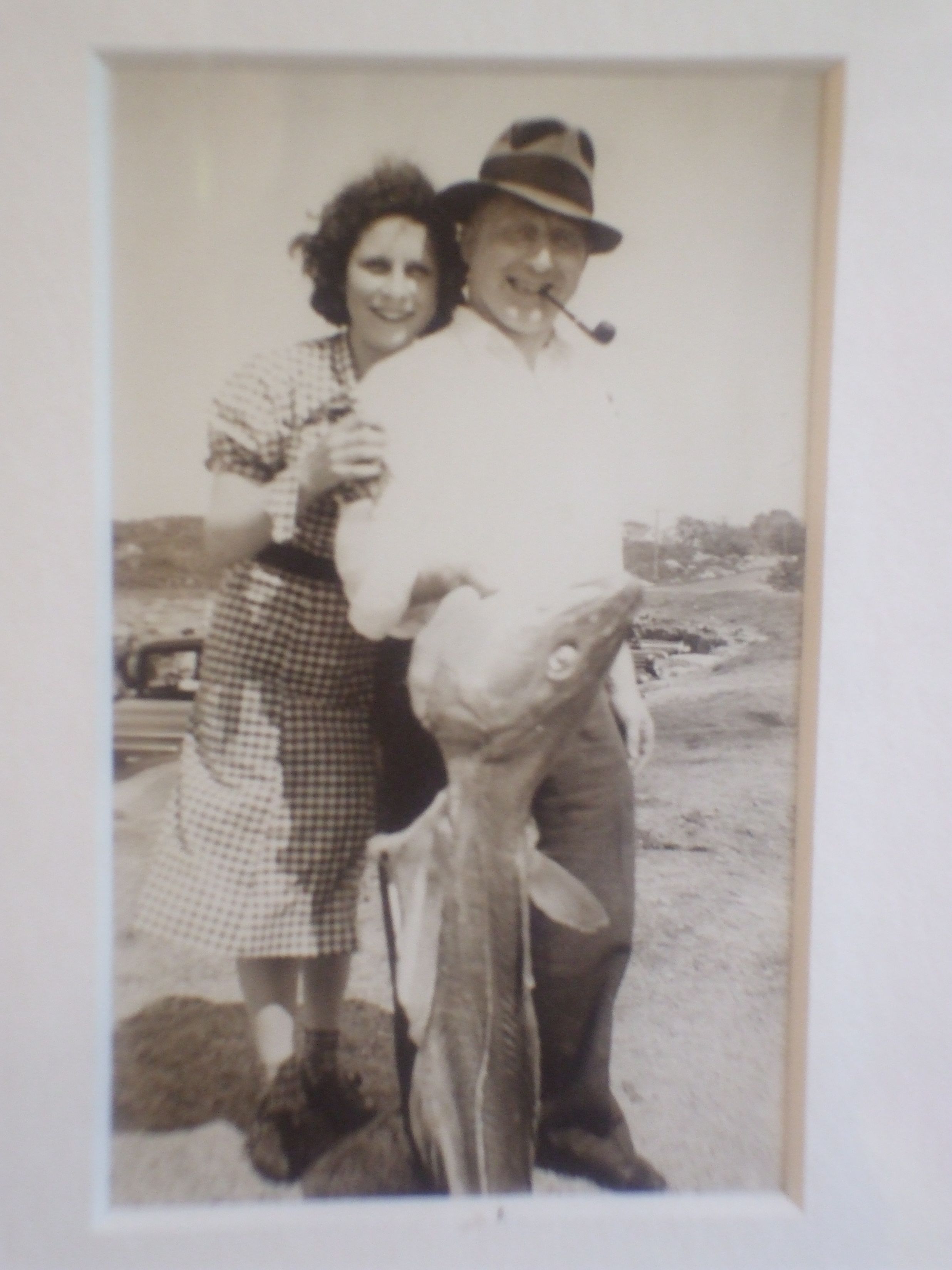
My grandfather would be just as proud of me for writing about these issues as he and my mother were of his big fish in the photo below.  And he would be horrified to know that there would be a question about the safety of eating any fish I catch today.

He adored his grandchildren as I will my own if and when they materialize. And I’ll want to make sure they have the extras like he did (note the “Enclosed $1.00 for the cat’s milk”), but I also want them to have something that isn’t an “extra” at all: A planet where they can play outside, breath easy, catch—and even eat—a big fish or two.

*In this week’s New Yorker, Elizabeth Kolbert explains that global warming works on a time delay, writing “Behind this summer’s heat are greenhouse gases emitted decades ago.” She also notes that “Both President Obama and Mitt Romney have chosen to remain silent on the [climate change] issue, presumably because they see it as just too big a bummer.”

Inspired by Older Women

02 Monday Jul 2012

Posted by judithar321 in aging, art, health, inspiration, mid-life transition, music, writing

≈ 5 Comments

Tags

"Pilgrimage", Annie Leibovitz, Doris Kearns Goodwin, empty nest, feminism, Patty Larkin, role models, unemployment

Women who are in their sixties and older have been on my mind lately. While I have a few years before my own 60th birthday, I’m noticing that late middle-age/ early old age can be one of the most powerful and vibrant times in a woman’s life.

It started at a Patty Larkin concert that took place right here in Concord. I’ve listened to her music for years, but I’d never seen her in person.

If you’d asked me to describe her voice, I’d have told you that it has a smile in it. And after seeing her play, I can now say that, in fact, she does smile when she sings.

From where I sat, Larkin looked and sounded like a woman in her early forties. Her body is toned, and her smooth, youthful voice reveals none of the wear and tear that often comes with time. And the inventive way she noodled around on her electric guitar reminded me of my 29-year-old son, who plays and composes experimental music.

“How old do you think she is?” I asked my husband during intermission. He pulled out his smartphone and looked her up. “Sixty-one,” he told me. Really? Wow.

Close up she may not look quite as young as she does from afar, but the vibrancy and joy she exudes while performing is that of an artist at the height of her powers.

A few weeks later, another powerful, older woman came across my radar. I reviewed Lilly Ledbetter’s memoir, Grace and Grit: My Fight for Equal Pay and Fairness at Goodyear and Beyond.

After 19 years as a supervisor, Ledbetter learned that Goodyear was paying her significantly less than her male counterparts. She took her battle for fair pay all the way to the Supreme Court.

The court decided against her, ruling that the statute of limitations had run out on her claim. She lost her personal battle, but she had the guts (and grit) to persevere so that the rest of us wouldn’t be treated in the same way.

In one of his first official actions as President, Obama signed the Lilly Ledbetter Fair Pay Restoration Act, which provides a more reasonable time limit for such claims. Now in her early 70s, Ledbetter went from the factory floor, to testify before Congress.

While reading Ledbetter’s memoir — which I could barely put down—I was reminded of how filthy factory work is (I welded electronic bug zappers during college), and of the gauntlet many women must run when they work with men who are unable to check their sexual urges at the workplace door.

Ledbetter isn’t an artist, nor is she a glamorous celebrity (though she’s both eloquent and elegant in words and appearance), but a regular person who grew up in poverty, worked grueling hours to help support her family,  and then became a spokeswoman for us all. She is forever on my list of inspirational women.

Then last week, at another event in town, I heard historian Doris Kearns Goodwin, 69, and photographer Annie Leibovitz, 62, discuss Leibovitz’s latest project, “Pilgrimage,” which is currently on exhibit at the Concord Museum.

These two smart, articulate women shared personal stories filled with self-deprecating humor. And while Goodwin awakened my somewhat dormant interest in history, my focus was on Leibovitz.

“Pilgrimage” is a photographic study of places and the personal effects, work, and surroundings of several historical figures. Some of them, Thoreau, Emerson, and Louisa May Alcott once lived here in Concord.

Leibovitz began the project during a difficult time in her own life. She needed to do something that wasn’t an editor’s assignment, but that was instead self-driven and that satisfied her own interests and curiousity. In healing herself, she did what many of us do —what I do when I’m overwhelmed, sad, or in a rut — she shifted gears and focused on the minutiae.

While I might weed the garden, detail the house, or start a cooking project, Leibovitz focused her camera on the light outside Emerson’s window, the beat-up surface of Virginia Woolf’s desk, and Georgia O’Keefe’s box of handmade pastels.

Both Leibovitz and Goodwin agreed that it is these kinds of details that make the person come alive. Later, as I walked through the exhibit past photographs of Annie Oakley’s riding boots, Marion Anderson’s concert gown, and the top edge of Eleanor Roosevelt’s desk drawer, etched with her signature, they came alive for me too.

Rather than becoming diminished as they age, these women are only getting stronger. I have heard women my own age complain that they feel invisible. With no regular job and an empty nest, I occasionally feel this way too.

Women like these show us that we don’t have to fade away.  If we keep working, doing, and learning, we can be better, we can do more.

I leave you with another video of Patty Larkin. Check out the way she works that electric guitar with her bow.

Taking Care of the Ground Beneath Our Feet

16 Monday Apr 2012

Posted by judithar321 in environment, health, meditation, politics

≈ 2 Comments

Tags

new growth, whole earth, willow tree

Last week, while writing about environmental mindfulness for Mom’s Clean Air Force, I began reading Cradle to Cradle by William McDonough and Michael Braungart.

One an architect, the other a chemist, the two authors challenge the belief that human industry must damage the natural world. “Why not take nature itself as our model for making things?” they ask.

They assert that it is possible to design manmade objects that maintain their usefulness throughout their lifespan and even give back to the planet upon their demise.

Such design would include what they call “technical nutrients” as well as biological ones. Whatever the product, it would start its life without the use of hazardous materials. The design for a commercial carpet, for example, would include a plan to ensure that its life span will be safe and useful from beginning to end.

“… carpeting designed as a true technical nutrient would be made of safe materials designed to be truly recycled as raw material for fresh carpeting …,” write McDonough and Braungart.

The more I learn about environmental hazards, the more I realize how much my daily activities impact our planet. I’m not suggesting that we all go back to the land and become luddites. But I do want to be more aware of what I’m taking away from our planet and what, if anything, I am giving back.

I also want to keep the pressure on Congress to support mercury standards and on business to adopt environmentally safe practices. Their bottom line won’t amount to much if they destroy the planet.

Mother nature provides us with daily miracles. See how she is?

Even in death our weeping willow tree continues to sprout new leaves.

And her rich, loamy core continues to nourish other plants and micro-organisms.

Like this dear old tree, our Mother Earth will keep giving and giving until her great heart finally gives out. I want to do the same for her. I’m not being particularly altruistic here. My survival, my children’s survival, their children’s survival — and their ability to thrive— all depend on her continued health.

Inside a Potter’s Studio, a Daughter Finds Answers

08 Thursday Mar 2012

Posted by judithar321 in aging, art, friendship, health, inspiration

≈ 8 Comments

Tags

Elizabeth Cohen, friendship, grief, loss, motherless daughters, osteoporosis, Parkinson's disease, pottery

A few weeks ago I hung up the phone after a brief chat with my stepmother and burst into tears. “Why so sad?” I wondered.

About to enter her 89th year, and plagued by Parkinson’s disease, it makes sense that I would be sad after hearing her faint voice leak across the wires. But I sensed that this feeling of loss went much, much deeper.

Edith married my father two years after my mother died. I was nineteen years old, a college sophomore. Although I have grown fond of her as the years have passed, I greeted her arrival in my life with ambivalence.

She was in her early fifties when she met my father, and had never been married. As a result, she was completely clueless when it came to dealing with an angry, grieving teenager. We now get along just fine, and she has been a good grandmother to my children, but the deep well of loss I felt that day was not just for her.

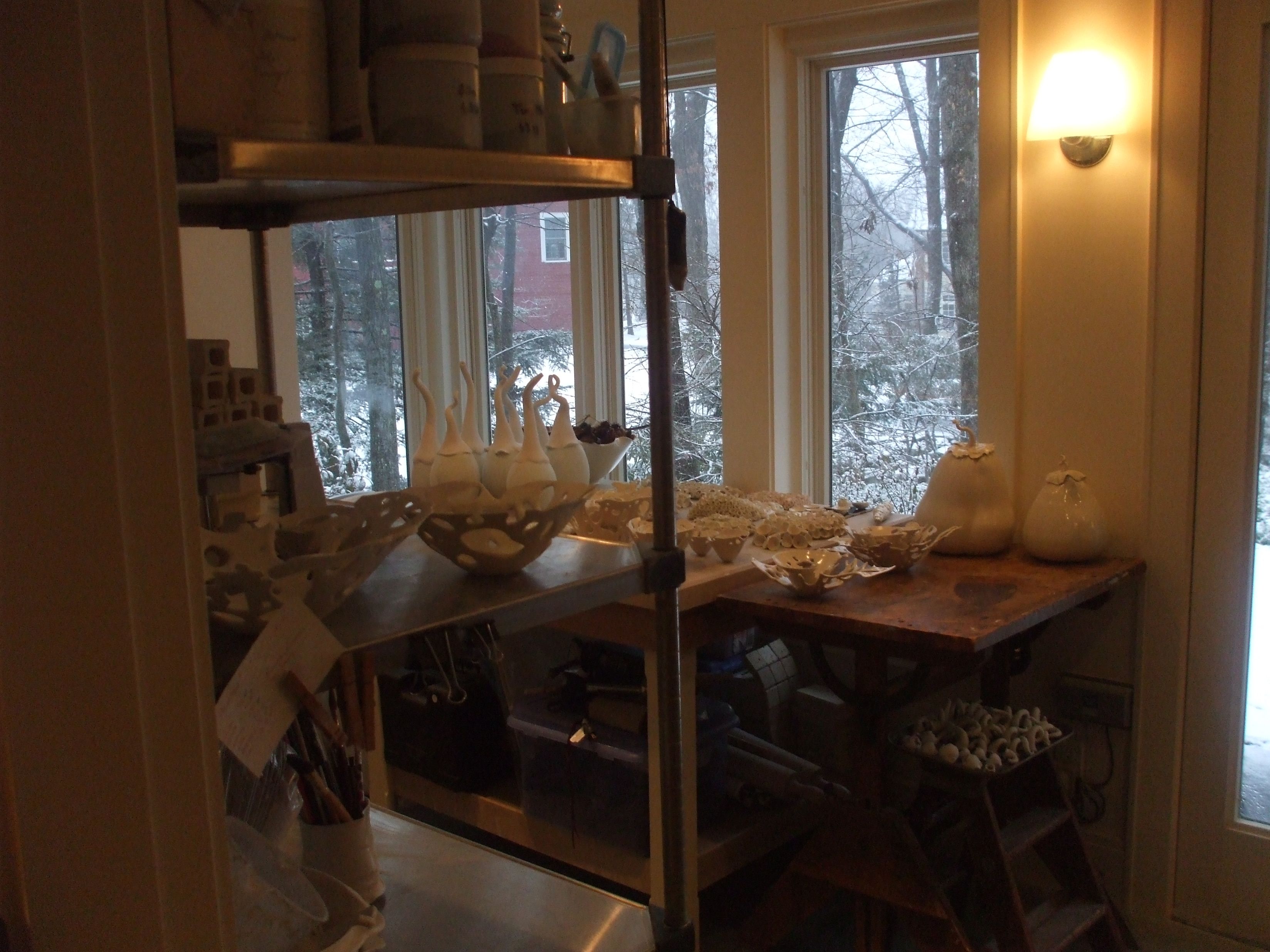
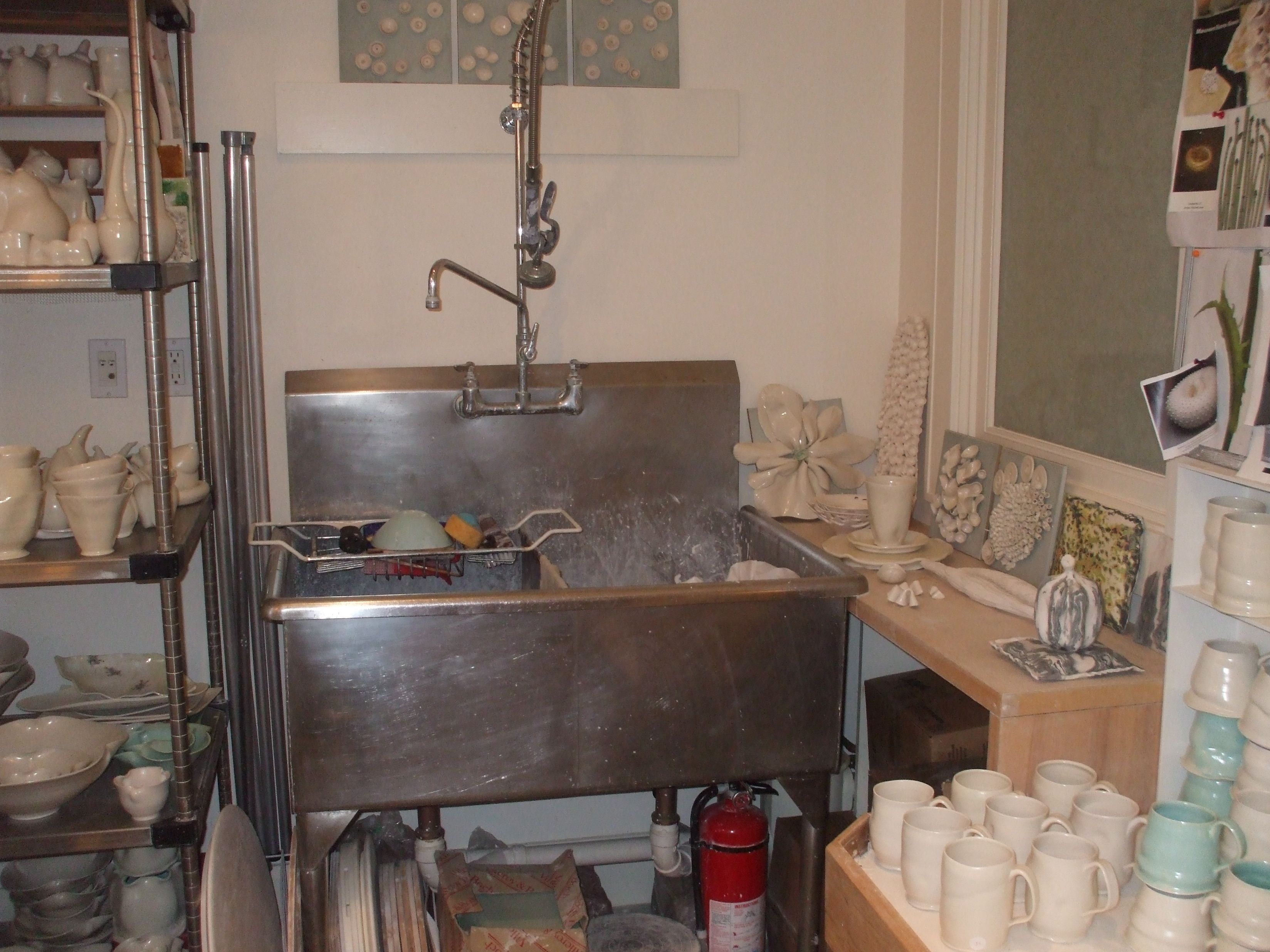
Then, on a wet, snowy Thursday, a new friend and I visited Elizabeth Cohen’s pottery studio.  Art was everywhere, beginning with her front steps.

These concrete leaves were made by another local artist.

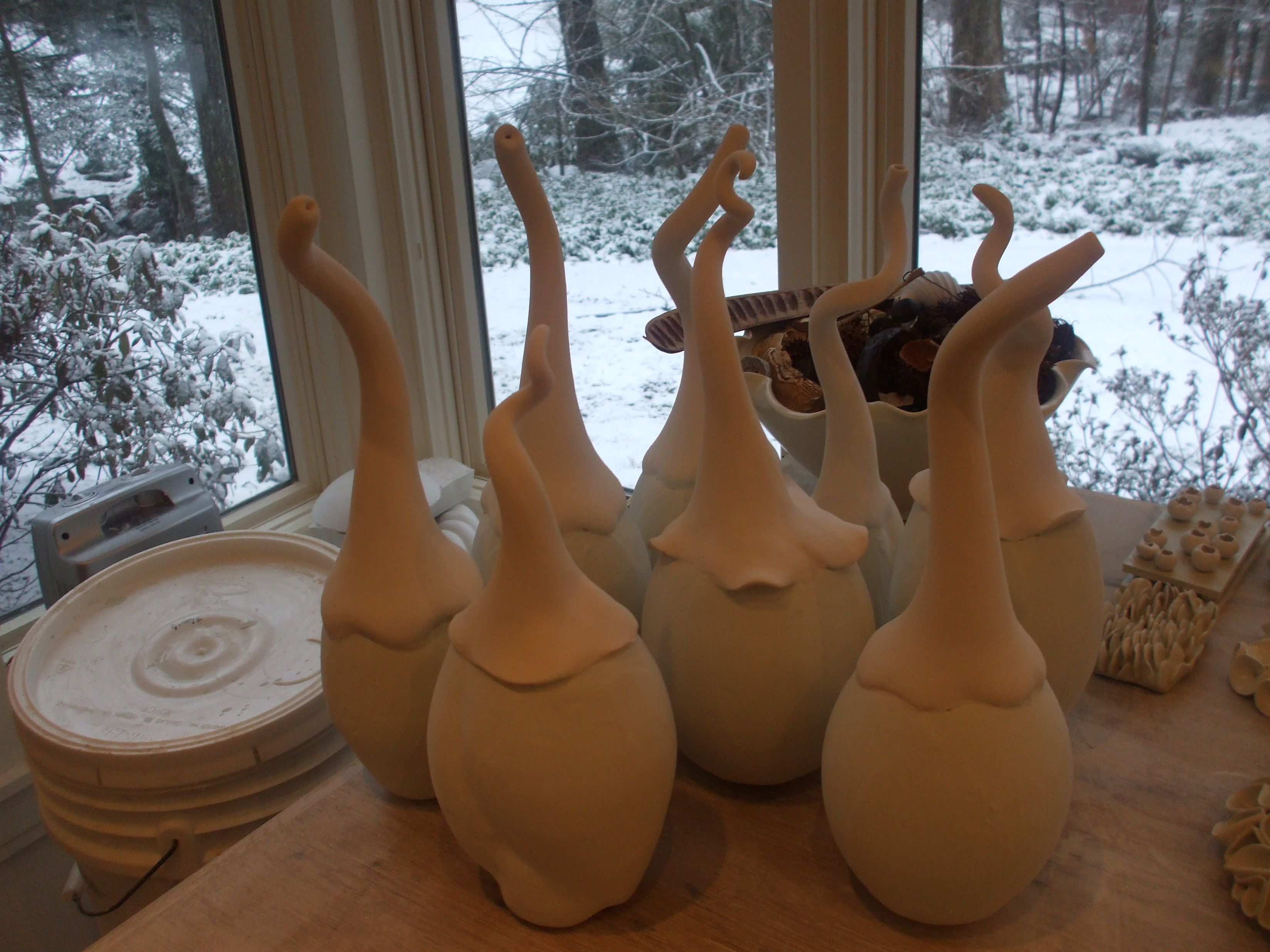
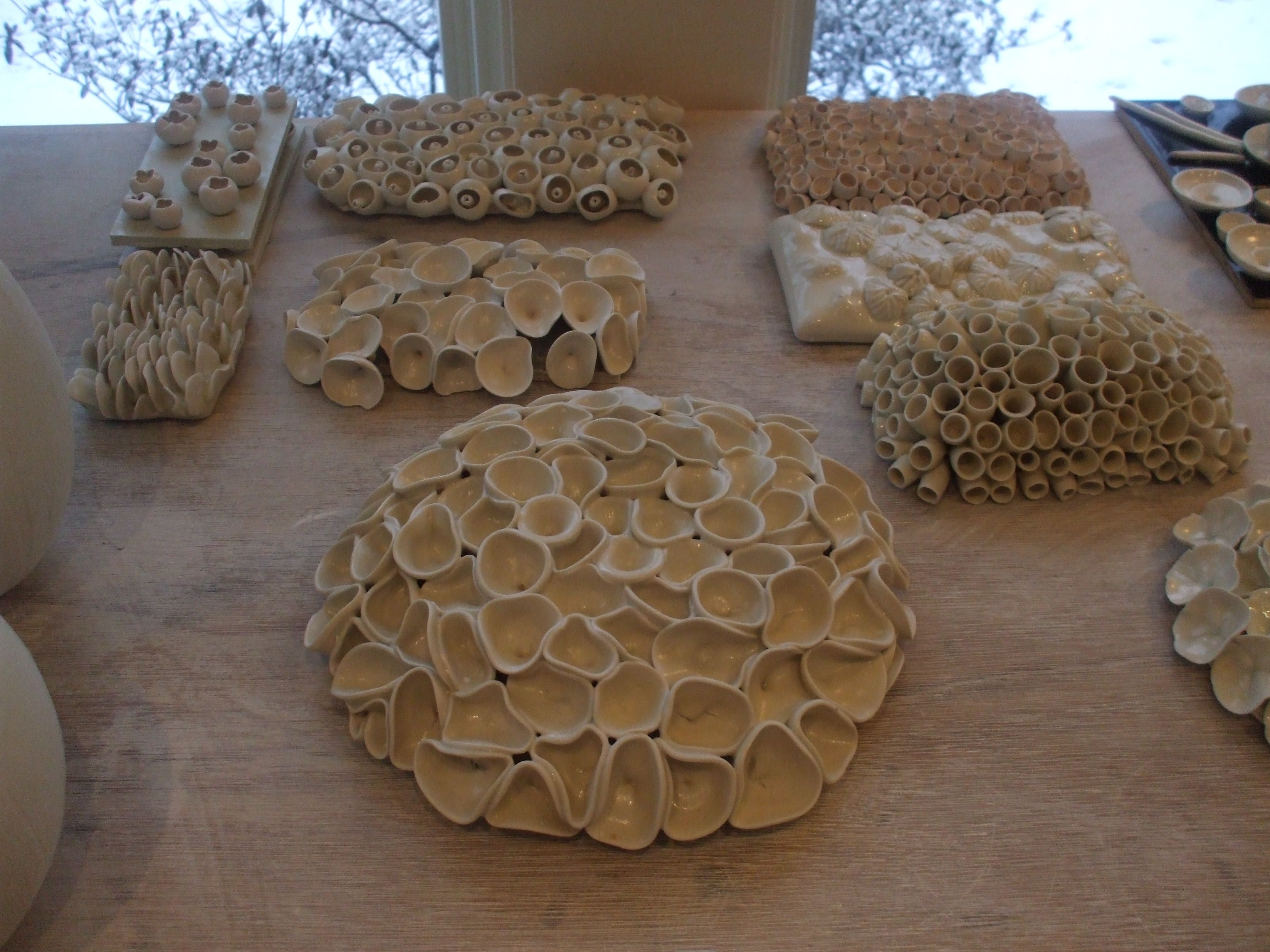
Her studio was small, but held a multitude of porcelain objects in varying shades of cream, while just outside the window the falling snow whitened the air, the trees, and the ground,

Inside the kiln.

Her mugs mold themselves right into your hands.  I now own four of them.

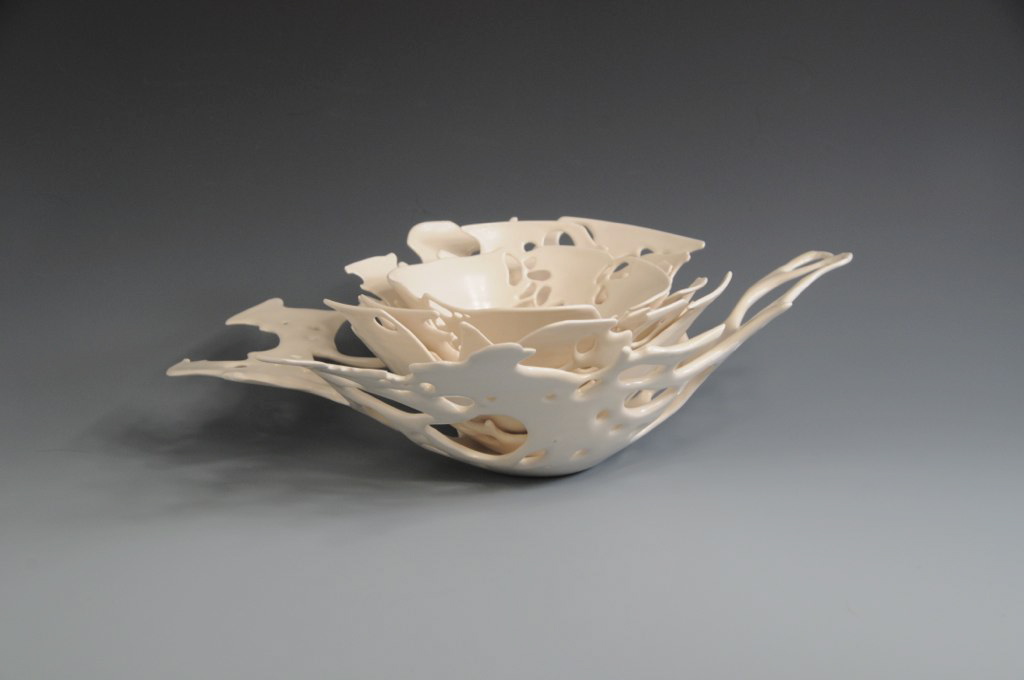
But the piece that struck me the most was a set of carved nesting bowls. It looked so fragile that I was afraid to touch it, even through my camera lens. Here’s a photo of it taken by Elizabeth.

© Elizabeth Cohen

The three of us paused over the piece while Elizabeth explained that her mother had died in the past year, and that these carved porcelain nesting bowls had been inspired by her aging bones. My friend, who is something of an expert when it comes to beautiful objects, seemed particularly taken by them.

As the snow ended, and the weekend came and went, I rolled the image of those bony bowls over and over in my mind. Eventually, it all came together, the sadness, the delicately carved porcelain — the smaller, more solid pieces nestled into the larger more porous ones.

It occurred to me, as it did when I married my husband, and birthed my children, that here was yet another event that I wouldn’t share with my mother. I’d never witness her body’s natural aging process — her bones becoming brittle, her hair turning white. She would again be absent, not there to show me the way. Indeed, I am already seven years older than she was when she died.

That’s one reason why watching my stepmother’s decline has awakened an old, old sadness. And yet, thinking back to my afternoon in that cozy studio, surrounded by white both inside and out, I know something else too.

I am not so alone. I was happy as I explored that creative nest, getting to know two other women: One my age, the other a bit younger, one who whips up confections with words, the other who does the same with clay.

I will miss my mother until the day I die, just as I’ll never stop looking for her in my family, friends, and in the new people I meet. She will be forever gone and gone too soon. But each layer of connection I make is like those bowls: I will cradle some, and others will cradle me.

Together, we will all find our way.

Confession: I don’t really hate pink.

05 Sunday Feb 2012

Posted by judithar321 in adult children, environment, health, politics

≈ 11 Comments

Tags

breast cancer, corporate branding, pink, Planned Parenthood, Susan G. Komen Foundation

In light of Susan G. Komen for the Cure’s recent decision, now reversed,* to stop funding Planned Parenthood’s program providing breast cancer screenings to low income women, this post was going to be about how much I dislike pink —especially the pink ribbons that have come to symbolize breast cancer.

I was going to insert the following quote from Barbara Ehrenreich’s article, “Welcome to Cancer Land,” in which she describes her “induction into breast cancer,” and eloquently documents how the color pink and teddy bears associated with it infantilize women diagnosed with this deadly and dead-serious disease. (And by the way, men get it too.)

For me at least, breast cancer will never be a source of identity or pride. As my dying correspondent Gerri wrote: “IT IS NOT O.K.!” What it is, along with cancer generally or any slow and painful way of dying, is an abomination, and, to the extent that it’s manmade, also a crime. This is the one great truth that I bring out of the breast-cancer experience, which did not, I can now report, make me prettier or stronger, more feminine or spiritual — only more deeply angry. What sustained me through the “treatments” is a purifying rage, a resolve, framed in the sleepless nights of chemotherapy, to see the last polluter, along with, say, the last smug health insurance operative, strangled with the last pink ribbon. Cancer or no cancer, I will not live that long of course. But I know this much right now for sure: I will not go into that last good night with a teddy bear tucked under my arm.

I was going to talk about how the pink ribbons, teddy bears, product placement, and corporate cancer-related branding strategies go hand-in-hand with our inhumane health care system, where the need to throw a bake sale to help pay for an uninsured neighbor’s heart surgery or a child’s leukemia treatments is considered acceptable.

But I’m not going to write about any of that. Why should I let those annoying pink ribbons spoil my appreciation of a perfectly good color? Instead, I’m going to take back the pink by sharing a few of my favorite rosy-hued objects.

First, a painting that hangs on my bedroom wall. It was a birthday gift from my grandfather, Jacob Scheinfein. It was probably my last gift from him as he died shortly before my 11th birthday.

Birthday gift

Then earlier this week my friend, Jane Ward, published a post about birthday cakes that included this memory from me.

My father was born on February 13. Every year on that day, my mother would pull out her heart-shaped cake pans, purchased just for that occasion. Being the 1960s, we opened a box of Duncan Hines cake mix, added an egg and water, poured the batter into the pans, and put them in the oven. The frosting was always pink.

In fact, it has been a week filled with pink. Yesterday, I came home with this bouquet of tulips. What’s not to like?

Bedroom bouquet

And just this morning, I had to make an emergency trip to CVS to pick up this item for my son.

Pepto Bismol pink

He’d eaten something that made him extremely and violently ill. The fact that he is now well enough to sit up, drink some ginger ale, and eat a few crackers makes me appreciate this particular shade of pink most of all.

*This short clip on NPR includes an interview with Dr. Susan Love, a pioneer in breast cancer treatment. Dr. Love emphasizes the importance of funding research into the causes of breast cancer.

Newer posts →
A blog about travels near and far, daily life, and issues that are bigger than all of us.

Recent Posts

  • Intentions
  • From Concord to Concordia: A Late-Life Migration
  • Dear Mr. President, Please Don’t Extinguish My Energy Star
  • I Vote for Clean Air
  • Love at Last

Enter your email address to follow this blog and receive notifications of new posts by email.

Join 196 other subscribers

Blogroll

  • 3191 Miles Apart
  • 66 Square Feet
  • Athenas Head
  • econesting
  • Food and Fiction
  • Lost in Arles
  • Second Lives Club
  • Slow Love Life

Places my work appears

  • Center for Effective Philanthropy
  • Harvard Business Publishing
  • Moms Clean Air Force
  • Talking Writing
  • Women's Voices for Change

Archives

  • August 2017
  • May 2017
  • March 2017
  • October 2016
  • February 2016
  • December 2015
  • November 2015
  • July 2015
  • June 2015
  • April 2015
  • March 2015
  • February 2015
  • December 2014
  • November 2014
  • October 2014
  • July 2014
  • June 2014
  • May 2014
  • April 2014
  • March 2014
  • February 2014
  • January 2014
  • December 2013
  • November 2013
  • October 2013
  • September 2013
  • August 2013
  • July 2013
  • June 2013
  • May 2013
  • April 2013
  • March 2013
  • February 2013
  • January 2013
  • December 2012
  • November 2012
  • October 2012
  • September 2012
  • August 2012
  • July 2012
  • June 2012
  • May 2012
  • April 2012
  • March 2012
  • February 2012
  • January 2012

Categories

  • adult children
  • aging
  • art
  • books
  • discipline
  • environment
  • friendship
  • health
  • inspiration
  • marriage
  • meditation
  • mid-life transition
  • music
  • pets
  • politics
  • travel
  • uncategorized
  • work
  • writing

Twitter

Tweets by judithaross

Blog at WordPress.com.

Privacy & Cookies: This site uses cookies. By continuing to use this website, you agree to their use.
To find out more, including how to control cookies, see here: Cookie Policy
  • Subscribe Subscribed
    • Shifting Gears
    • Join 196 other subscribers
    • Already have a WordPress.com account? Log in now.
    • Shifting Gears
    • Subscribe Subscribed
    • Sign up
    • Log in
    • Report this content
    • View site in Reader
    • Manage subscriptions
    • Collapse this bar
 

Loading Comments...